Zero-Sum Bias

aka Zero-Sum Thinking · Zero-Sum Heuristic · Fixed-Pie Bias

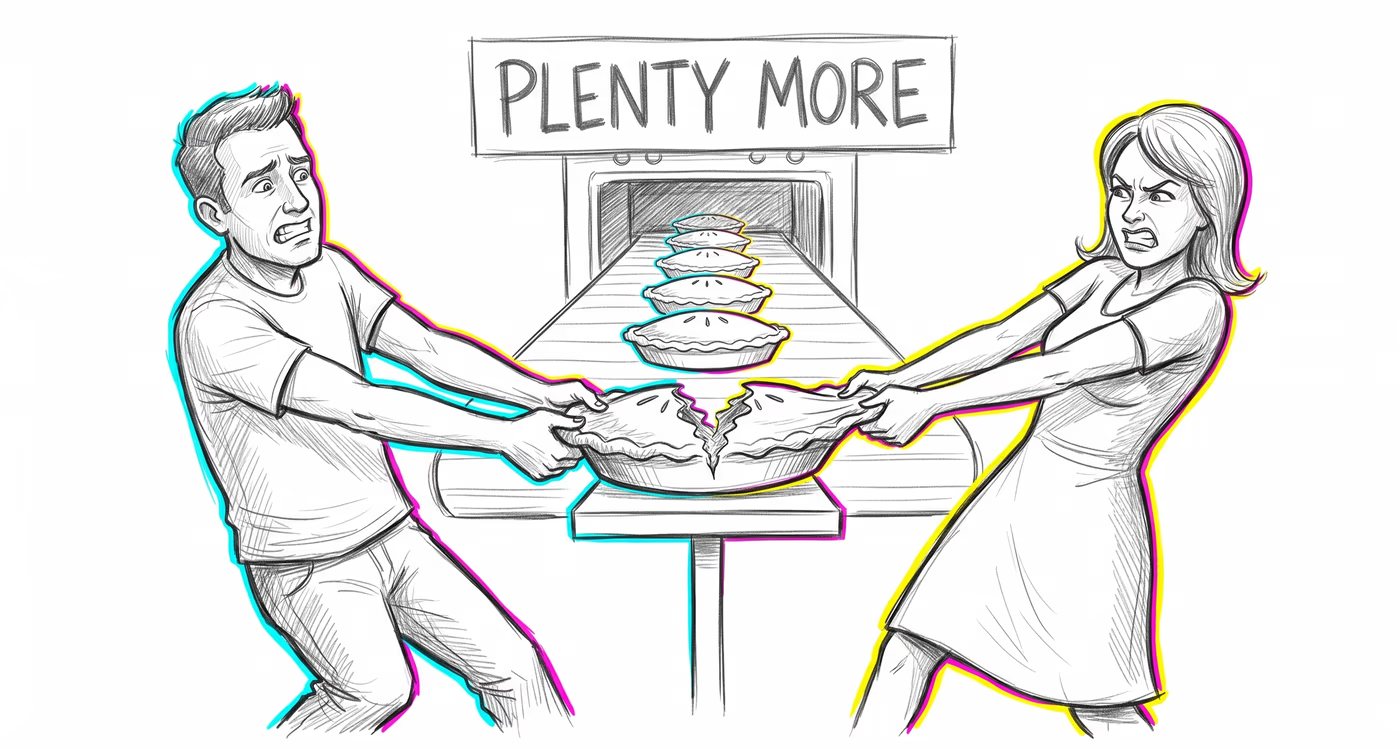
Assuming one person's gain must come at another's expense, even in situations where everyone could benefit.

WHAT IT IS

The glitch, explained plainly.

Imagine you and your friend both want cookies, and you think there are only 10 cookies in the whole world. If your friend gets 3, you think that means you can only get 7. But actually, someone is baking more cookies all the time! Zero-sum bias is when you think someone else winning means you're losing, even when there's plenty for everyone.

Zero-sum bias describes the cognitive tendency to frame interactions, resource distributions, and social outcomes as inherently competitive, even when the situation objectively allows for shared gains. People exhibiting this bias assume that any benefit obtained by another person or group must be accompanied by an equivalent loss to themselves or their group, treating life as though all resources exist in a fixed pool. This bias is especially pronounced when desirable resources are being allocated and when people perceive themselves in competition with out-groups. It undermines cooperation, fuels intergroup hostility, and prevents individuals from recognizing or pursuing mutually beneficial solutions that would leave all parties better off.

SOUND FAMILIAR?

Where it shows up.

  1. 01 A city council member opposes a new public library branch in a neighboring district, arguing that funding it will inevitably reduce services at existing branches. In reality, the library system's budget is expanding due to new state grants, and the new branch is fully funded independently of existing operations.
  2. 02 During a team meeting, Marcus objects to hiring a highly talented new engineer, insisting that adding someone so skilled will make the rest of the team look bad by comparison and reduce their chances of promotion. His manager points out that the company promotes based on individual performance and the new hire will actually help the team deliver more, creating additional promotion opportunities.
  3. 03 A trade union lobbies against allowing skilled immigrants to enter the workforce, arguing that every job filled by an immigrant is one fewer job for a domestic worker. Economic research in the region has consistently shown that skilled immigration increases demand for complementary domestic labor and grows the total number of jobs, but the union leadership cannot accept that both groups could benefit simultaneously.
  4. 04 A venture capitalist passes on investing in a startup because another well-known VC firm is also investing. She reasons that if the other firm captures value from the deal, there must be less value left for her. She overlooks that both investors could profit substantially from a company whose total market value is growing rapidly.
  5. 05 A researcher at a university discourages a junior colleague from publishing a paper on a related topic, believing that attention and citations in their niche field are finite — any recognition the junior colleague receives must come at the expense of the senior researcher's own citation count. In fact, more publications in the niche increase overall visibility and citations for everyone working in the area.
IN DIFFERENT DOMAINS

Where it shows up at work.

The same glitch looks different depending on the terrain. Finance, medicine, a relationship, a team — same mechanism, different costume.

Finance & investing

Investors and the public often view international trade as inherently win-lose, believing that a trade surplus for one country must mean a deficit-driven loss for another, which leads to resistance against free trade agreements even when both economies would grow from the exchange.
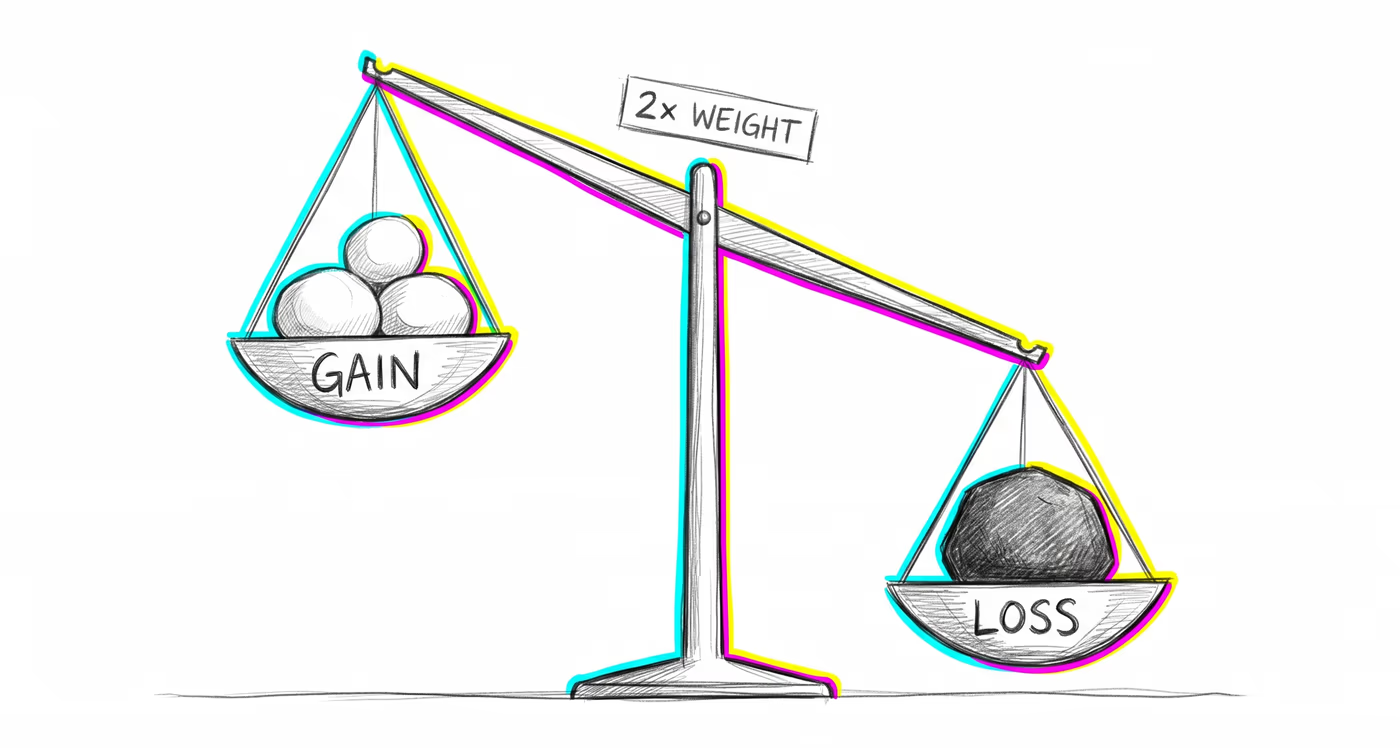

Medicine & diagnosis

Patients may resist organ donation programs or public health resource allocation if they believe that directing medical resources toward one group of patients necessarily deprives their own group of care, even when total healthcare capacity is expandable.

Education & grading

Students commonly perceive grading as competitive even in absolute grading systems, believing that classmates' high grades reduce the likelihood of their own high grades, which discourages collaboration and peer tutoring.

Relationships

Partners often perceive love, attention, and emotional investment as fixed quantities, leading to jealousy or resentment when a partner devotes time to friendships, hobbies, or family — as though every hour spent elsewhere is an hour stolen from the relationship.

Tech & product

Product teams may resist open-source contributions or API sharing, believing that helping competitors or the community grow will directly reduce their own market share, even when ecosystem growth could expand the total addressable market for everyone.

Workplace & hiring

Employees may view colleague promotions, raises, or public recognition as threats to their own advancement, creating adversarial dynamics in teams where collaboration would actually improve outcomes for all members.

Politics Media

Politicians frame civil rights expansions for minority groups as losses for majority groups, and media narratives about immigration frequently adopt a zero-sum frame — portraying immigrants' economic gains as directly causing native workers' losses, even when evidence shows net economic growth.

HOW TO SPOT IT

Ask yourself…

  • Am I assuming that someone else's gain must come at my expense, or could we both benefit here?
  • Is this resource actually fixed and finite, or am I treating a growable resource as though it's a pie that can't get bigger?
  • Am I framing this situation as a competition when cooperation might produce better outcomes for everyone involved?
HOW TO DEFEND AGAINST IT

The playbook.

  • Before reacting to someone else's gain, explicitly ask: 'Is this actually a fixed-pie situation, or could the pie grow?' Write down the evidence for each.
  • Practice 'positive-sum scanning': when you notice a competitive framing, deliberately brainstorm three ways both parties could benefit from the situation.
  • Seek out concrete data on whether the resource in question is truly limited — research market growth, budget structures, or grading policies rather than relying on intuition.
  • Use perspective-taking exercises: imagine how the other party views the situation and whether they also see it as competitive. Their cooperation signals often reveal positive-sum potential.
  • Study basic economics of value creation — understanding how trade, specialization, and innovation grow total resources helps override the scarcity heuristic.
FAMOUS CASES

In history.

  • Mercantilist trade policies of the 17th-18th centuries were driven by the zero-sum belief that global wealth was fixed and one nation's trade surplus necessarily meant another's impoverishment, motivating colonial resource extraction and trade wars.
  • The 'lump of labor' fallacy has repeatedly influenced labor policy, such as France's 35-hour workweek law (2000), based partly on the zero-sum assumption that there is a fixed amount of work to be distributed among workers.
  • Research by Norton and Sommers (2011) documented that white Americans increasingly perceive anti-white bias as rising in proportion to decreases in anti-Black bias, treating racial equality as a zero-sum competition.
WHERE IT COMES FROM
Academic origin

Daniel V. Meegan formally introduced the term 'zero-sum bias' in a 2010 paper published in Frontiers in Psychology. The broader concept of zero-sum thinking draws on game theory foundations laid by von Neumann and Morgenstern (1944) and was elaborated cross-culturally by Różycka-Tran, Boski, and Wojciszke in their 2015 37-nation study.

Evolutionary origin

In ancestral environments, critical resources like food, mates, territory, and social status were genuinely scarce and often truly zero-sum. An individual who failed to recognize and respond to competitive resource dynamics risked losing survival-critical resources. A cognitive bias toward assuming competition — even when occasionally wrong — was less costly than failing to compete when resources were truly limited. The slow pace of technological progress during human evolution meant no individual would have observed resource growth in their lifetime, making zero-sum the rational default model.

IN AI SYSTEMS

How the machines inherit it.

When training data reflects zero-sum social dynamics — such as historical hiring data where one demographic's advancement correlated with another's decline — ML models can encode and perpetuate these competitive assumptions as if they are causal rules rather than artifacts of past discrimination. Recommendation algorithms may also exhibit zero-sum patterns by treating user engagement as a fixed resource, aggressively competing content against itself rather than expanding total engagement time.

Read more on Wikipedia
FREE FIELD ZINE

10 glitches quietly running your life.

A free field-zine PDF — ten cognitive glitches named, illustrated, with a defense move for each. Plus the weekly Glitch Report on Fridays — one bias named, two spotted in the wild, one defense move. Unsubscribe any time.

EXPLORE MORE

Related glitches.

LAUNCH PRICE

Train against your blindspots.

50 cards are free to preview. Buyers unlock the rest of the deck plus the interactive training — Spot-the-Bias Quiz unlimited, Swipe Deck with spaced repetition, My Blindspots, Decision Pre-Flight, the Printable Deck + Cheat Sheets, and the Field Guide e-book. $29.50$59.

Unlock the full deck

Everything below — yours forever. Pay once, use across every device.

Half-off launch — limited to the first 100 readers. Auto-applied at checkout.
$59 $29.50
one-time payment · lifetime access
  • All interactive digital cards — search, filter, flip, shuffle on any device
  • Five training modes — Spot-the-Bias Quiz, Swipe Deck, Pre-Flight, Blindspots, Journal
  • Curated Lenses + Decision Templates + Defense Playbook
  • Printable Deck PDFs + Field Guide e-book + Cheat Sheets + Anki Export
  • Every future improvement, included
Unlock  $29.50

30-day refund · no questions asked

Unlock the full deck

Everything below — yours forever. Pay once, use across every device.

Half-off launch — limited to the first 100 readers. Auto-applied at checkout.
$59 $29.50
one-time payment · lifetime access
  • All interactive digital cards — search, filter, flip, shuffle on any device
  • Five training modes — Spot-the-Bias Quiz, Swipe Deck, Pre-Flight, Blindspots, Journal
  • Curated Lenses + Decision Templates + Defense Playbook
  • Printable Deck PDFs + Field Guide e-book + Cheat Sheets + Anki Export
  • Every future improvement, included
Unlock  $29.50

30-day refund · no questions asked