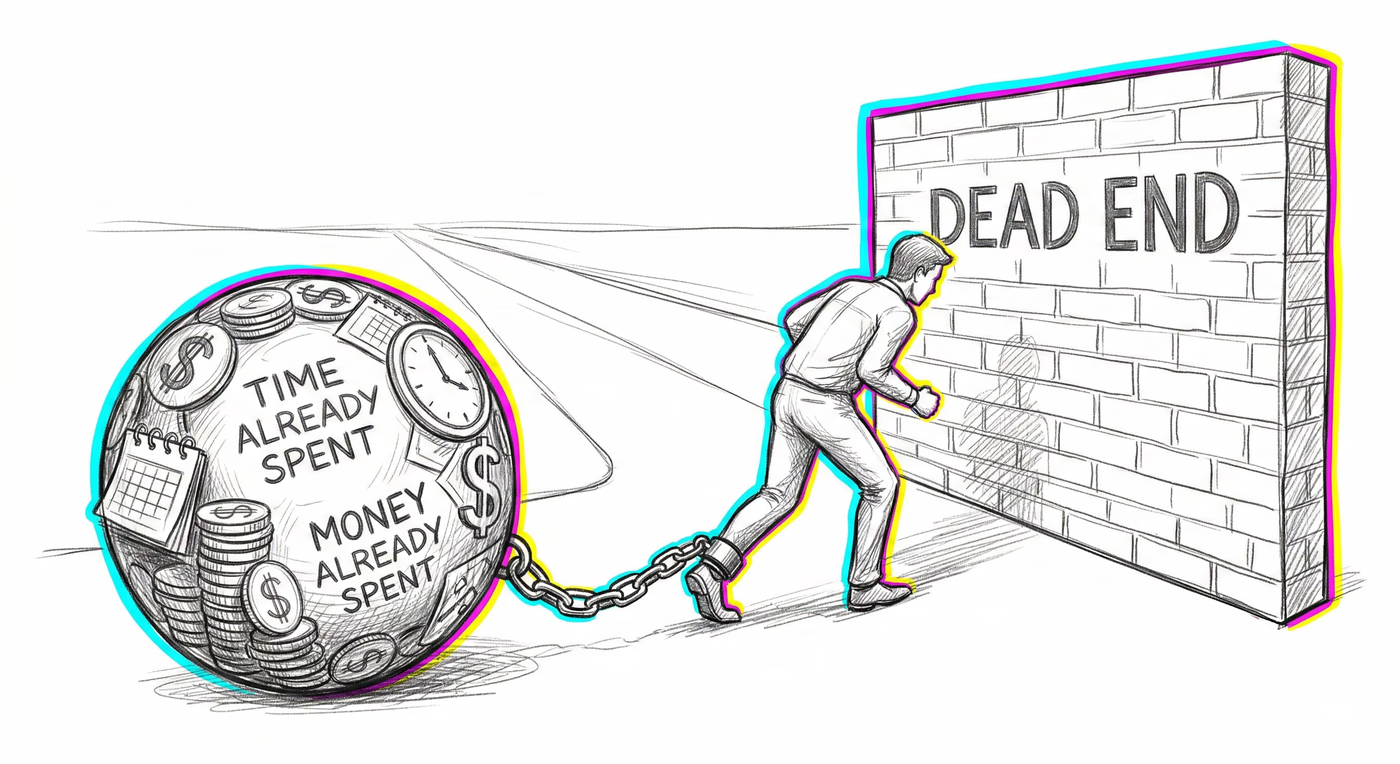
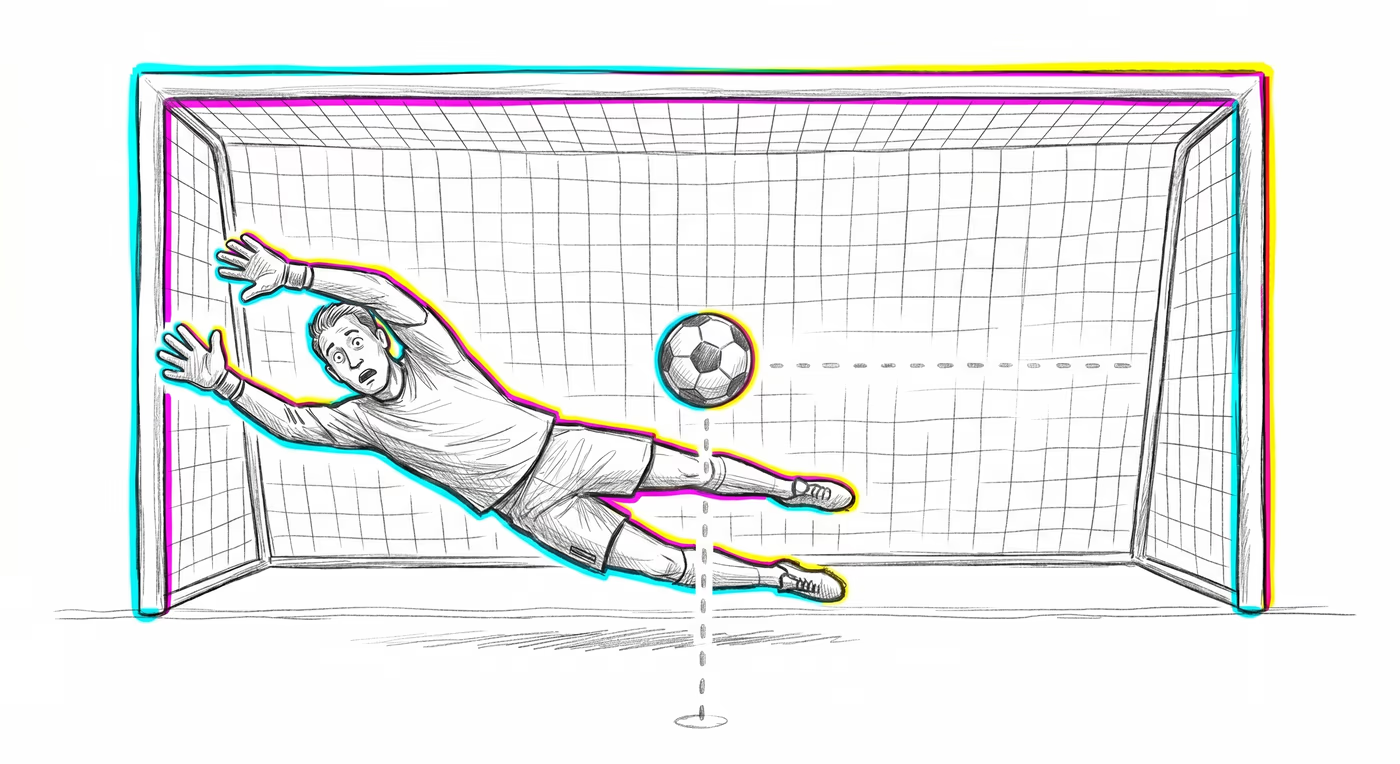
Additive Bias

aka Addition Bias · Additive Thinking Bias · Subtraction Neglect

The systematic tendency to solve problems by adding new elements rather than removing existing ones, even when subtraction would produce a simpler or more effective solution.

Illustration: Additive Bias
WHAT IT IS

The glitch, explained plainly.

Imagine you're building a Lego bridge and one tower is taller than the other. Most people reach for more blocks to make the short tower taller. But a kid might just pull one block off the tall tower—that's quicker and easier! Our brains are like that: whenever something is wrong, we think 'what can I add to fix it?' instead of 'what can I take away?' It's like always putting more toppings on a pizza that already has too much instead of removing the one topping that makes it taste bad.

Additive bias describes the deeply ingrained human default of searching for solutions that involve adding components—features, rules, steps, materials—rather than considering whether removing components would be more effective. When people attempt to improve objects, ideas, or situations, additive transformations come to mind more quickly and with less cognitive effort, causing subtractive alternatives to be systematically overlooked. This bias intensifies under cognitive load, time pressure, and when individuals have limited opportunities to reconsider their initial approach. The result is that people routinely miss simpler, more elegant solutions that involve taking away rather than piling on, contributing to bloated systems, overburdened schedules, and unnecessary complexity across virtually every domain of life.

SOUND FAMILIAR?

Where it shows up.

  1. 01 A project manager notices that the team's weekly status meetings run too long and aren't productive. She responds by adding a new pre-meeting agenda template, a digital timer for each speaker, and a follow-up form. The meetings are now even more process-heavy. She never considered simply canceling two of the four weekly meetings.
  2. 02 A software team receives feedback that their app is confusing for new users. The lead designer proposes adding an onboarding tutorial, tooltip popups, and a help center section. The team implements all three. Nobody suggests that the confusion stems from three redundant navigation paths that could simply be removed to make the interface intuitive without explanation.
  3. 03 A city government wants to reduce traffic congestion. Officials propose building new bypass roads, adding a carpool lane, and installing smart traffic signals. An urban planner's suggestion to close one specific through-road—which research shows would reduce overall congestion by redistributing flow—is barely discussed because it feels counterintuitive to remove infrastructure to solve a capacity problem.
  4. 04 A writer struggling with a novel's pacing adds a new subplot and two secondary characters to make the middle section more engaging. Her writing group loves the additions. Months later, an editor points out that removing one existing subplot that slowed momentum would have fixed the pacing more effectively and kept the novel 40 pages shorter.
  5. 05 A university curriculum committee reviews declining student satisfaction scores for a degree program. They approve three new elective courses, a mentorship program, and a capstone seminar. Satisfaction ticks up slightly. A visiting accreditor later notes that simply removing two redundant prerequisite courses—which students consistently identified as the primary frustration—would have addressed the core complaint more directly and at zero cost.
IN DIFFERENT DOMAINS

Where it shows up at work.

The same glitch looks different depending on the terrain. Finance, medicine, a relationship, a team — same mechanism, different costume.

Finance & investing

Investors and financial planners tend to address portfolio weaknesses by adding new asset classes, instruments, or hedging strategies rather than removing underperforming holdings or simplifying overly complex allocation structures, leading to portfolio bloat and higher management fees.

Medicine & diagnosis

When treatment plans aren't working optimally, clinicians tend to add new medications, therapies, or diagnostic tests rather than considering deprescribing unnecessary drugs or eliminating redundant procedures—a pattern that contributes to polypharmacy and iatrogenic harm, particularly in elderly patients.

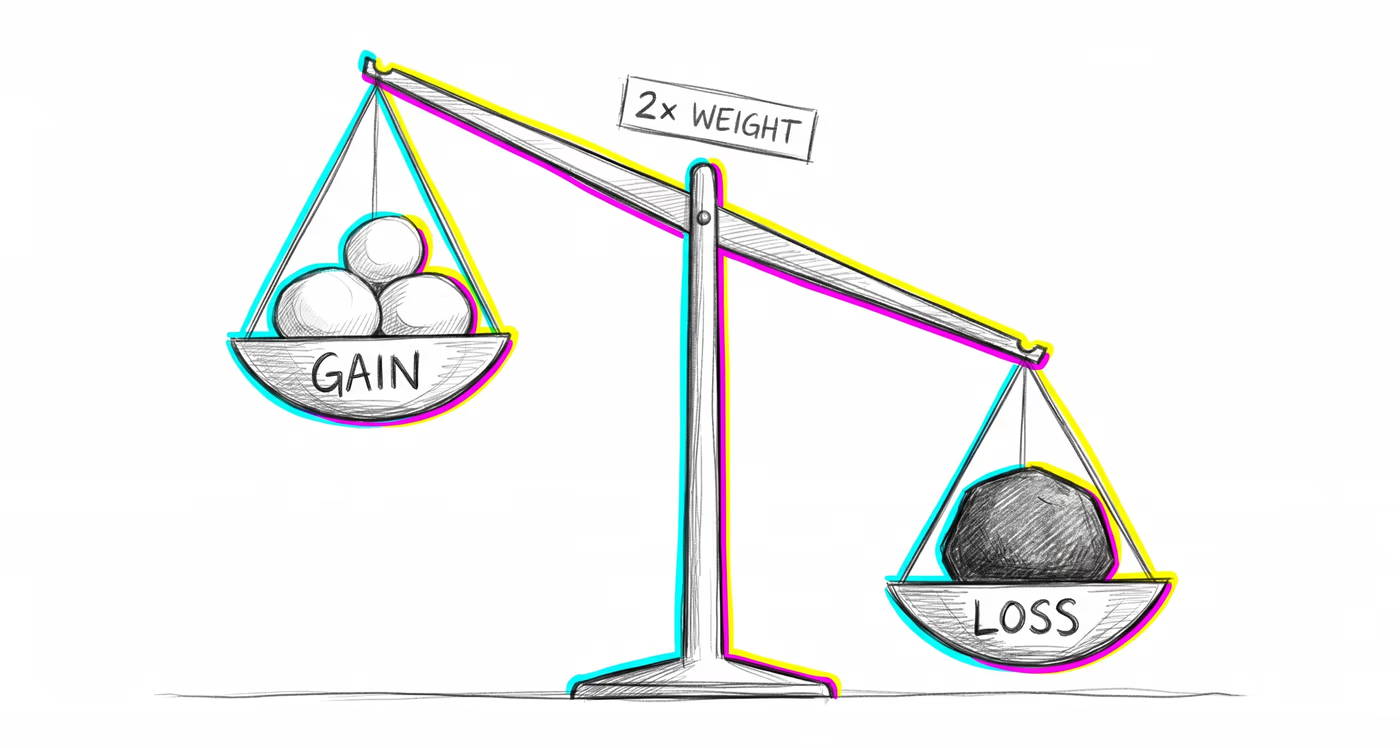
Education & grading

Schools respond to educational shortcomings by adding new programs, assessments, and curricular requirements rather than removing outdated content, redundant testing, or ineffective mandates—leading to teacher burnout and student cognitive overload from an ever-expanding set of demands.

Relationships

When a relationship feels stale, partners tend to propose adding new activities, date nights, or relationship rituals rather than considering what existing commitments, habits, or unresolved tensions to remove that are consuming the time and energy needed for genuine connection.

Tech & product

Product teams default to adding features, settings, and options in response to user complaints rather than removing confusing elements or simplifying workflows, resulting in perpetual feature creep that makes products progressively harder to use despite being technically more capable.

Workplace & hiring

Organizations address inefficiencies by adding new processes, approval layers, reporting requirements, and oversight roles rather than eliminating redundant workflows, unnecessary meetings, or obsolete policies—leading to bureaucratic bloat that compounds over time.

Politics Media

Governments respond to social problems by adding new regulations, agencies, and programs rather than evaluating and removing existing ones that are ineffective or counterproductive, contributing to regulatory bloat and institutional complexity that makes governance less efficient.

HOW TO SPOT IT

Ask yourself…

  • Am I proposing to add something new, and have I genuinely considered whether removing something existing would solve the problem more simply?
  • If I forced myself to solve this problem only by subtraction, what would I remove—and would that solution actually be better?
  • Am I under time pressure or cognitive load right now, which might be causing me to default to the first (additive) idea that came to mind?
HOW TO DEFEND AGAINST IT

The playbook.

  • Before finalizing any solution, explicitly ask: 'What could I remove instead of add?' Make this a mandatory step in your decision process.
  • Use 'subtraction audits': periodically review systems, schedules, or projects with the sole goal of identifying what to eliminate.
  • When brainstorming, run a dedicated 'subtraction round' where only subtractive solutions are permitted.
  • Reduce cognitive load before making decisions—the bias is strongest when you're mentally taxed.
  • Reframe subtraction positively as 'revealing,' 'streamlining,' or 'clarifying' rather than as 'removing' or 'losing.'
FAMOUS CASES

In history.

  • The U.S. tax code has grown from roughly 400 pages in 1913 to over 70,000 pages through decades of adding provisions, credits, and exceptions, with virtually no successful large-scale simplification efforts despite widespread recognition of its complexity.
  • Microsoft Word and similar software products became increasingly bloated through decades of feature additions, prompting competitors like Google Docs to gain market share partly by offering a deliberately stripped-down alternative.
  • The removal of pedals from children's bicycles to create balance bikes (commercialized around 2007) was a rare subtractive innovation that took nearly a century to conceive despite children's bicycles being heavily iterated upon with additive changes like training wheels, multiple gears, and shock absorbers.
WHERE IT COMES FROM
Academic origin

Gabrielle S. Adams, Benjamin A. Converse, Andrew H. Hales, and Leidy E. Klotz, University of Virginia, 2021. Formally published as 'People systematically overlook subtractive changes' in Nature, volume 592, April 2021.

Evolutionary origin

In ancestral environments characterized by scarcity, accumulation was nearly always adaptive. Gathering more food, more tools, more shelter materials, and more allies increased survival probability. Subtraction—voluntarily giving things up—was rarely advantageous when resources were scarce and unpredictable. The brain therefore developed a rapid default toward accumulation and addition as the primary problem-solving strategy, as the cost of adding unnecessarily was low compared to the cost of subtracting something vital.

IN AI SYSTEMS

How the machines inherit it.

Machine learning systems exhibit additive bias when models are made more complex (adding layers, features, or parameters) to improve performance rather than pruning unnecessary components. In recommendation systems and content algorithms, the default is to add new signals and data sources rather than simplifying models by removing noisy or low-value inputs. LLMs tend to generate verbose, additive responses and struggle to recommend removal or simplification unless explicitly prompted, reflecting training data where human solutions disproportionately favor addition.

Read more on Wikipedia
FREE FIELD ZINE

10 glitches quietly running your life.

A free field-zine PDF — ten cognitive glitches named, illustrated, with a defense move for each. Plus the weekly Glitch Report on Fridays — one bias named, two spotted in the wild, one defense move. Unsubscribe any time.

EXPLORE MORE

Related glitches.

LAUNCH PRICE

Train against your blindspots.

50 cards are free to preview. Buyers unlock the rest of the deck plus the interactive training — Spot-the-Bias Quiz unlimited, Swipe Deck with spaced repetition, My Blindspots, Decision Pre-Flight, the Printable Deck + Cheat Sheets, and the Field Guide e-book. $29.50$59.

Unlock the full deck

Everything below — yours forever. Pay once, use across every device.

Half-off launch — limited to the first 100 readers. Auto-applied at checkout.
$59 $29.50
one-time payment · lifetime access
  • All interactive digital cards — search, filter, flip, shuffle on any device
  • Five training modes — Spot-the-Bias Quiz, Swipe Deck, Pre-Flight, Blindspots, Journal
  • Curated Lenses + Decision Templates + Defense Playbook
  • Printable Deck PDFs + Field Guide e-book + Cheat Sheets + Anki Export
  • Every future improvement, included
Unlock  $29.50

30-day refund · no questions asked

Unlock the full deck

Everything below — yours forever. Pay once, use across every device.

Half-off launch — limited to the first 100 readers. Auto-applied at checkout.
$59 $29.50
one-time payment · lifetime access
  • All interactive digital cards — search, filter, flip, shuffle on any device
  • Five training modes — Spot-the-Bias Quiz, Swipe Deck, Pre-Flight, Blindspots, Journal
  • Curated Lenses + Decision Templates + Defense Playbook
  • Printable Deck PDFs + Field Guide e-book + Cheat Sheets + Anki Export
  • Every future improvement, included
Unlock  $29.50

30-day refund · no questions asked