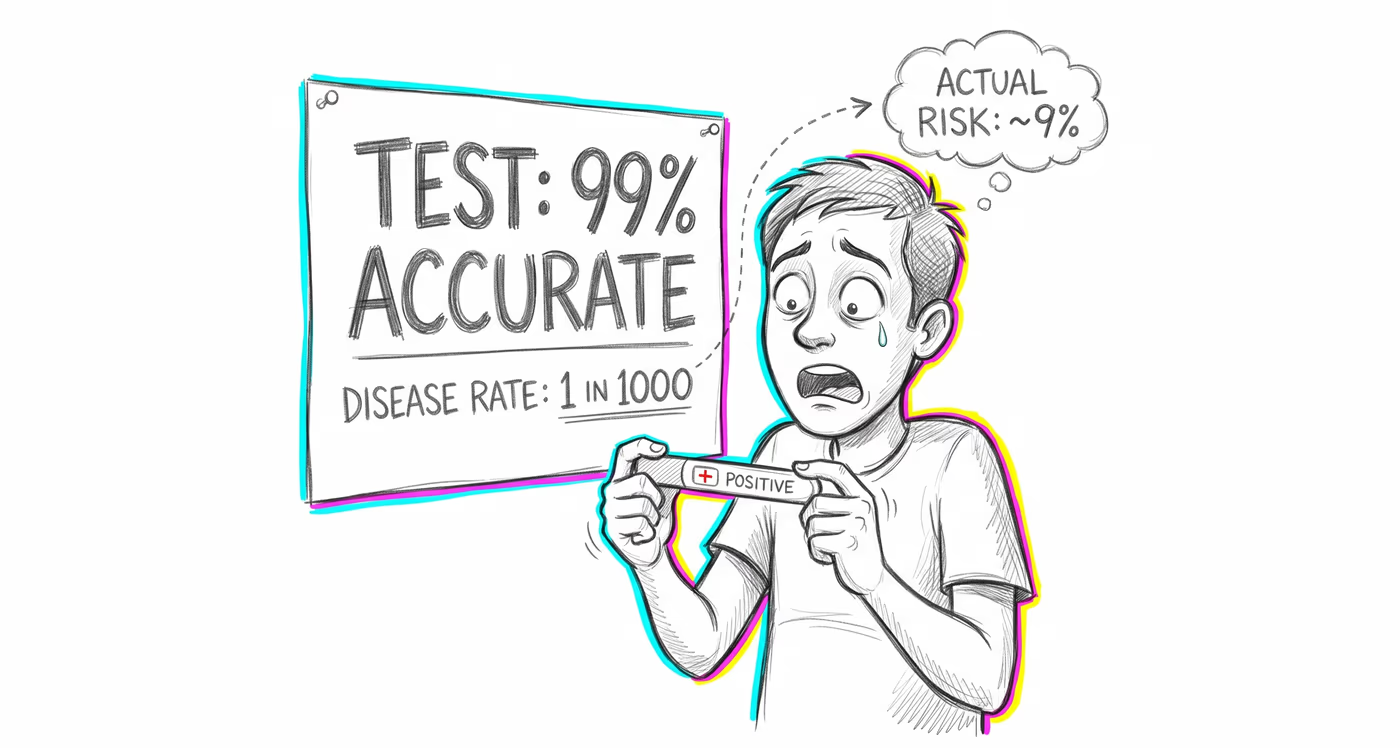
Attribute Substitution

aka Substitution Bias · Question Substitution · Heuristic Substitution

Unconsciously answering an easier question than the one actually asked, without realizing a swap occurred.

Illustration: Attribute Substitution
WHAT IT IS

The glitch, explained plainly.

Imagine your teacher asks you a really hard math question and you don't know the answer. Instead of saying 'I don't know,' your brain sneakily answers a different, easier question that sounds similar — and you don't even notice you changed the question. It's like being asked 'Which fruit is the most nutritious?' but your brain answers 'Which fruit do I like the taste of?' because that's easier to figure out.

Attribute substitution is a meta-cognitive process in which the brain, when confronted with a question requiring effortful computation (the 'target attribute'), seamlessly swaps in an answer derived from an easier, more accessible property (the 'heuristic attribute'). Three conditions must be met: the target attribute must be relatively inaccessible, a related heuristic attribute must be highly accessible (often through priming, emotional salience, or automatic perceptual processing), and the slower reflective system must fail to detect and correct the swap. The theory, formalized by Kahneman and Frederick in 2002, unifies many previously separate heuristic effects — including availability, representativeness, and affect heuristic — under a single explanatory framework, showing that each is a specific instance of substituting one attribute for another.

SOUND FAMILIAR?

Where it shows up.

  1. 01 A hiring manager needs to evaluate whether a candidate will be a strong long-term performer. Instead of analyzing the candidate's track record and skills in detail, she notices the candidate is confident, articulate, and tall, and rates them highly — unconsciously answering 'Do they seem impressive?' instead of 'Will they perform well over three years?'
  2. 02 A city council is debating whether to fund a new flood barrier. A councilmember who recently watched a documentary about hurricanes feels strongly that the project is urgent. She votes yes with conviction, not realizing her sense of urgency comes from how easily she can picture a flood — not from the actual probability data presented in the engineering report.
  3. 03 Travelers offered insurance against death from a terrorist attack while traveling in Europe were willing to pay more than a separate group offered insurance against death from any cause on the same trip. The narrower, more emotionally vivid scenario generated a stronger feeling of risk, which people unknowingly used as their estimate of the probability — even though 'any cause' logically includes terrorism.
  4. 04 A doctor is asked to estimate whether a patient's chest pain indicates cardiac disease. The patient is anxious, sweating, and visibly distressed. The doctor rates cardiac risk as high, partly because the emotional intensity of the patient's presentation is being unconsciously swapped in for the actual diagnostic probability, even though anxiety alone can produce identical symptoms.
  5. 05 A software architect is asked to estimate project complexity for a new system. She finds the system's user interface mockups elegant and intuitive. She gives a low complexity estimate, not realizing she has answered 'How simple does the front end look?' instead of 'How architecturally complex is the full-stack implementation?'
IN DIFFERENT DOMAINS

Where it shows up at work.

The same glitch looks different depending on the terrain. Finance, medicine, a relationship, a team — same mechanism, different costume.

Finance & investing

Investors frequently substitute the question 'Is this company a good investment?' with 'Do I have a good feeling about this company?' or 'Have I heard of this brand?', leading to decisions driven by familiarity or emotional resonance rather than fundamental analysis of earnings, debt ratios, and growth trajectories.
Medicine & diagnosis

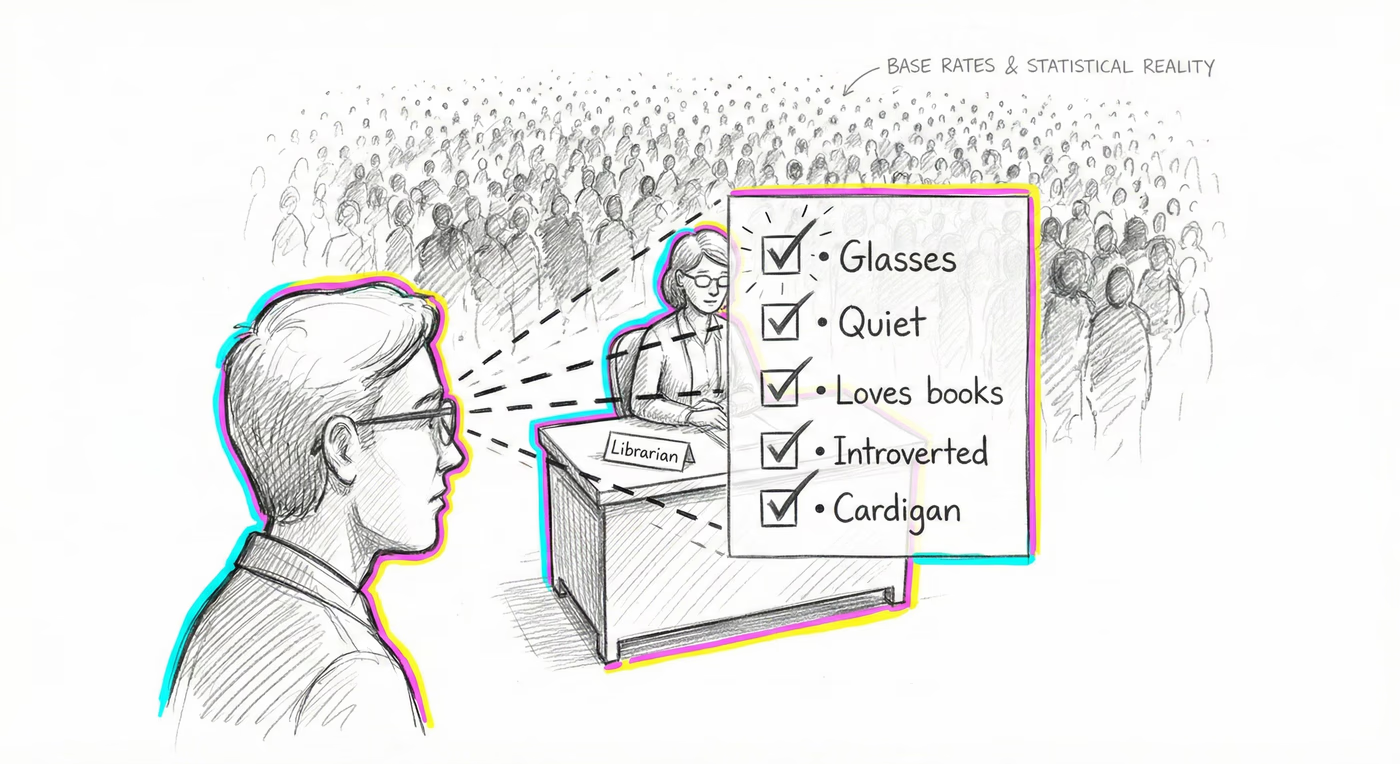
Clinicians may substitute 'What is the statistical probability of this diagnosis?' with 'How easily can I recall a similar case?' — particularly when a patient's presentation is emotionally striking or matches a vivid recent experience, leading to diagnostic errors that deviate from base rates.

Education & grading

Teachers evaluating student potential may substitute 'How capable is this student academically?' with 'How articulate and engaged does this student seem in class?', systematically overestimating charismatic but underprepared students and underestimating quiet but capable ones.

Relationships

People evaluating long-term compatibility with a romantic partner often substitute the complex question 'Are we fundamentally compatible?' with the simpler 'How do I feel around them right now?', mistaking present emotional intensity or physical attraction for deep relational fitness.

Tech & product

Product teams asked 'Is this feature useful?' may unconsciously answer 'Is this feature visually polished?' — leading to investment in aesthetically pleasing but functionally weak features, while overlooking powerful but visually plain capabilities.

Workplace & hiring

Performance reviewers may substitute 'How productive has this employee been this year?' with 'How do I feel about this person generally?' or 'What do I remember from the last few weeks?', leading to ratings driven by recency or interpersonal warmth rather than cumulative output.

Politics Media

Voters asked 'Which candidate has the best policy platform?' often answer 'Which candidate do I like more personally?' or 'Which candidate makes me feel safer?' — substituting emotional resonance and likability for policy analysis.

HOW TO SPOT IT

Ask yourself…

  • Am I actually answering the question I was asked, or am I answering an easier, related question?
  • Is my judgment being driven by how I feel about this rather than by the specific data or criteria that matter?
  • Would my answer change if I wrote out the exact question and forced myself to address each component separately?
HOW TO DEFEND AGAINST IT

The playbook.

  • Explicitly write down the exact question you need to answer before forming a judgment, then check whether your answer actually addresses that specific question.
  • Use the 'decomposition' technique: break complex judgments into their component parts and evaluate each separately rather than relying on a single holistic impression.
  • Introduce a deliberate pause between the question and your answer — force System 2 engagement by counting to ten or stating the problem aloud.
  • Ask yourself: 'What would a statistician say?' or 'What does the data actually show?' to redirect from emotional or perceptual proxies to analytical targets.
  • Use checklists and structured decision frameworks that force attention to the actual criteria rather than allowing intuitive shortcuts.
FAMOUS CASES

In history.

  • Johnson, Hershey, Meszaros & Kunreuther (1993) found that people offered flight insurance covering 'death from terrorism' were willing to pay more than those offered insurance covering 'death from any cause,' demonstrating how emotional vividness of a specific scenario substitutes for probability reasoning — the narrower, more vivid framing generated a stronger feeling of risk despite being logically included within the broader category.
  • The bat-and-ball problem (Frederick, 2005): A bat and a ball cost $1.10 total, and the bat costs $1.00 more than the ball. Most people intuitively answer that the ball costs $0.10, but the correct answer is $0.05 — they substitute an easy subtraction for the required algebra, a finding replicated across populations including elite university students.
WHERE IT COMES FROM
Academic origin

Amos Tversky and Daniel Kahneman laid the groundwork in 1974 with their heuristics and biases program. The concept was formally named and theorized as 'attribute substitution' by Daniel Kahneman and Shane Frederick in 2002, in their chapter 'Representativeness Revisited: Attribute Substitution in Intuitive Judgment' published in Heuristics and Biases: The Psychology of Intuitive Judgment (Cambridge University Press).

Evolutionary origin

In ancestral environments, rapid judgment was often more valuable than precise judgment. When facing threats or opportunities, our ancestors who could quickly approximate danger using readily available cues like size, movement, or emotional intensity rather than carefully computing exact probabilities had a survival advantage. Substituting an easy-to-assess proxy for a hard-to-assess target allowed fast, good-enough decision-making under time pressure and uncertainty.

IN AI SYSTEMS

How the machines inherit it.

Machine learning systems perform a structural analog of attribute substitution when they optimize for a proxy metric that is easier to measure rather than the true target variable. A notable example is a healthcare algorithm that used 'health care costs' as a proxy for 'health care needs,' systematically underserving Black patients who had lower costs despite equal illness severity. Recommendation algorithms similarly substitute 'engagement' (easy to measure) for 'user satisfaction' (hard to measure), optimizing for clickbait over genuine value. LLMs may substitute fluency and coherence for factual accuracy, producing confident-sounding but incorrect answers.

Read more on Wikipedia
FREE FIELD ZINE

10 glitches quietly running your life.

A free field-zine PDF — ten cognitive glitches named, illustrated, with a defense move for each. Plus the weekly Glitch Report on Fridays — one bias named, two spotted in the wild, one defense move. Unsubscribe any time.

EXPLORE MORE

Related glitches.

LAUNCH PRICE

Train against your blindspots.

50 cards are free to preview. Buyers unlock the rest of the deck plus the interactive training — Spot-the-Bias Quiz unlimited, Swipe Deck with spaced repetition, My Blindspots, Decision Pre-Flight, the Printable Deck + Cheat Sheets, and the Field Guide e-book. $29.50$59.

Unlock the full deck

Everything below — yours forever. Pay once, use across every device.

Half-off launch — limited to the first 100 readers. Auto-applied at checkout.
$59 $29.50
one-time payment · lifetime access
  • All interactive digital cards — search, filter, flip, shuffle on any device
  • Five training modes — Spot-the-Bias Quiz, Swipe Deck, Pre-Flight, Blindspots, Journal
  • Curated Lenses + Decision Templates + Defense Playbook
  • Printable Deck PDFs + Field Guide e-book + Cheat Sheets + Anki Export
  • Every future improvement, included
Unlock  $29.50

30-day refund · no questions asked

Unlock the full deck

Everything below — yours forever. Pay once, use across every device.

Half-off launch — limited to the first 100 readers. Auto-applied at checkout.
$59 $29.50
one-time payment · lifetime access
  • All interactive digital cards — search, filter, flip, shuffle on any device
  • Five training modes — Spot-the-Bias Quiz, Swipe Deck, Pre-Flight, Blindspots, Journal
  • Curated Lenses + Decision Templates + Defense Playbook
  • Printable Deck PDFs + Field Guide e-book + Cheat Sheets + Anki Export
  • Every future improvement, included
Unlock  $29.50

30-day refund · no questions asked