Bias Blind Spot

aka Bias Blind Spot · Bias Blind Spot Effect

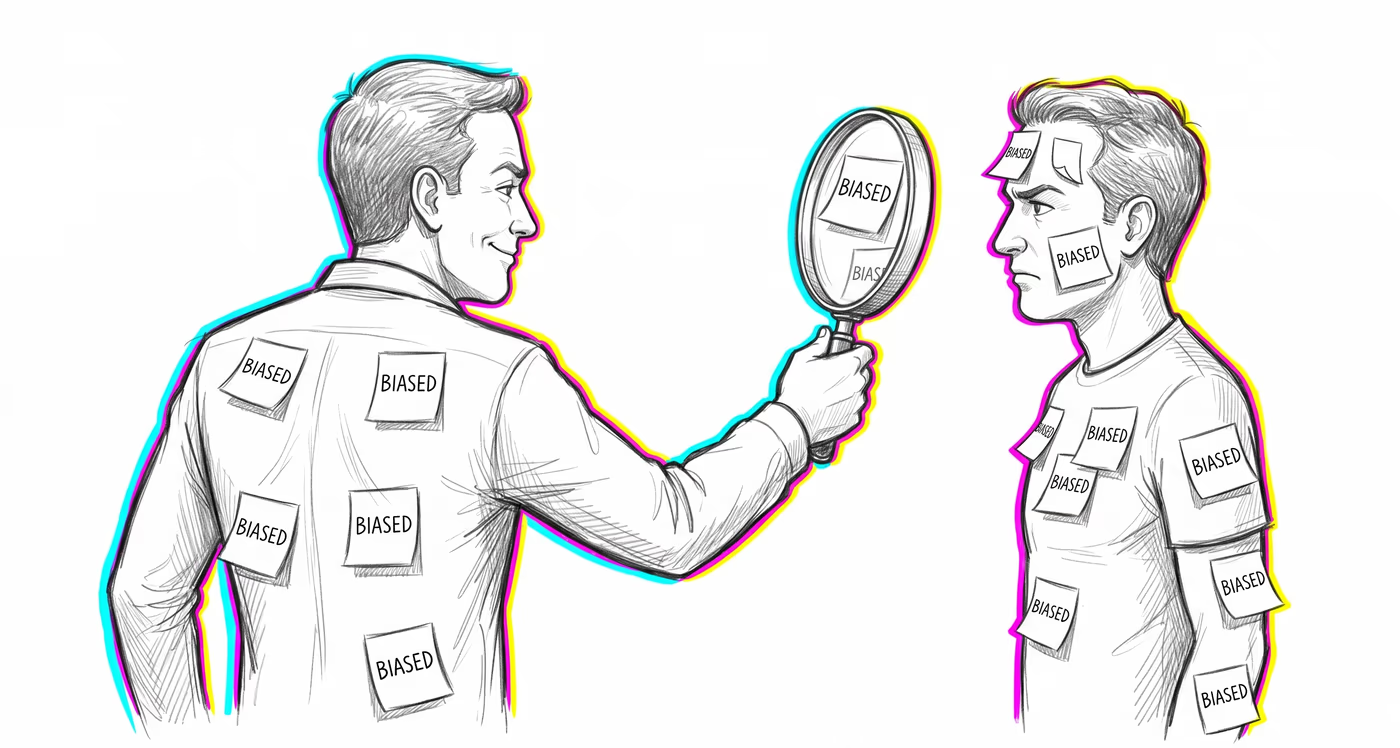
Easily spotting cognitive biases in others while believing your own judgment is objective and bias-free.

Illustration: Bias Blind Spot
WHAT IT IS

The glitch, explained plainly.

Imagine you and your friend both have dirt on your faces. You can easily see the smudge on your friend's cheek, but you can't see your own because you don't have a mirror. You walk around thinking your face is perfectly clean while pointing out how dirty your friend is. That's what your brain does with its thinking mistakes — it spots them in everyone else but insists it doesn't have them.

Blind-Spot Bias describes the robust and persistent asymmetry in how people evaluate their own susceptibility to cognitive biases compared to that of others. Individuals readily identify systematic errors in other people's reasoning — such as confirmation bias, self-serving attributions, or anchoring — yet sincerely believe their own judgments are relatively objective and bias-free. This asymmetry is fueled by three reinforcing mechanisms: naive realism (the conviction that one perceives the world as it truly is), the introspection illusion (over-relying on internal thoughts and intentions when assessing one's own objectivity while judging others by their observable behavior), and self-enhancement motives (the desire to maintain a positive self-image). Crucially, this bias is not reduced by intelligence, education, or even explicit training about biases — in fact, smarter individuals sometimes show a larger blind spot because they trust their reasoning ability more.

SOUND FAMILIAR?

Where it shows up.

  1. 01 A mediator at a workplace dispute notices that both parties accuse each other of being unreasonable and blinded by personal interests. When asked if their own position might be similarly influenced, each party insists they have carefully examined their reasoning and found it to be fair and evidence-based.
  2. 02 After completing a corporate training on unconscious bias, a hiring manager begins closely scrutinizing her colleagues' interview evaluations for signs of bias. However, she exempts her own evaluations from the same scrutiny, reasoning that since she now understands bias, she would certainly notice if it were affecting her own decisions.
  3. 03 A financial analyst reads a study showing that investment professionals are prone to overconfidence bias. He agrees that the finding applies broadly to his industry but concludes that his own track record demonstrates he is one of the few genuinely calibrated forecasters, despite having no objective evidence to support that self-assessment.
  4. 04 A researcher presents her findings at a conference and a colleague challenges her methodology, suggesting it may reflect confirmation bias. She dismisses the critique, reasoning that she knows her own thought process and was genuinely following the data — while simultaneously suspecting her colleague's objection is motivated by professional jealousy rather than legitimate concern.
  5. 05 A psychology professor who teaches a full semester course on cognitive biases writes a blog post arguing that most people lack the self-awareness to recognize their own biases. When a reader points out that the professor's own arguments might suffer from the same problem, the professor responds that years of studying bias have equipped him with sufficient introspective tools to detect it in himself — the very claim the research on this phenomenon shows to be unfounded.
IN DIFFERENT DOMAINS

Where it shows up at work.

The same glitch looks different depending on the terrain. Finance, medicine, a relationship, a team — same mechanism, different costume.

Finance & investing

Investment fund managers who acknowledge that behavioral biases distort market decisions in general nonetheless believe their own trading strategies are free of such influence, leading them to reject systematic debiasing protocols and ignore advisory input.

Medicine & diagnosis

Physicians accept that pharmaceutical gifts might unconsciously bias other doctors' prescribing behavior, yet believe their own prescribing remains purely evidence-based, making them resistant to conflict-of-interest policies they consider unnecessary for themselves.

Education & grading

Teachers who attend workshops on grading bias become adept at spotting favoritism in colleagues' assessments while remaining unaware that their own grading patterns systematically favor students who match their communication style or background.

Relationships

Partners readily identify each other's biased reasoning during arguments — noticing selective memory or emotional reasoning — while experiencing their own perspective as a clear-eyed account of what actually happened.

Tech & product

Product teams trained in UX biases vigilantly audit competitors' designs for dark patterns and manipulative framing while failing to recognize that their own A/B testing and feature prioritization are shaped by the same biases they critique.

Workplace & hiring

HR professionals trained in bias awareness more carefully scrutinize the hiring decisions of line managers for discrimination while remaining confident that their own candidate evaluations are objective and merit-based.

Politics Media

Partisans on both sides of an issue easily detect spin, cherry-picked data, and motivated reasoning in opposing media coverage while perceiving coverage aligned with their own views as straightforward reporting of facts.
HOW TO SPOT IT

Ask yourself…

  • Am I currently assuming my judgment on this matter is more objective than someone who disagrees with me?
  • If someone else made this exact decision with this exact reasoning, would I suspect bias in them?
  • Am I dismissing feedback about my own potential bias while readily accepting similar feedback about others?
HOW TO DEFEND AGAINST IT

The playbook.

  • Adopt the 'outsider test': Before defending your objectivity, ask how a neutral third party would evaluate your reasoning if they could see your full decision process.
  • Implement structural debiasing rather than relying on awareness: Use blind reviews, checklists, pre-commitment protocols, and decision audits that don't depend on self-detection.
  • Practice the 'bias symmetry assumption': When you identify a bias in someone else, immediately ask whether you might be exhibiting it yourself in a parallel situation.
  • Seek adversarial collaboration: Invite a trusted person with a different perspective to explicitly challenge your reasoning before you finalize important decisions.
  • Keep a decision journal and review past entries to identify patterns of bias you failed to notice in the moment.
FAMOUS CASES

In history.

  • The 2008 financial crisis: Many financial professionals recognized systemic risk-taking biases in the industry generally but believed their own risk assessments were sound, contributing to insufficient self-correction before the collapse.
  • Forensic science scandals: Forensic examiners in criminal cases acknowledged that cognitive biases can affect forensic judgment in general, yet surveys showed they believed their own analyses were largely immune, leading to resistance against blind evidence procedures.
  • The 2016 U.S. presidential election: Research documented that partisans on both sides perceived the opposing side as biased while viewing their own political reasoning as objective, fueling mutual demonization and polarization.
WHERE IT COMES FROM
Academic origin

Emily Pronin, Daniel Y. Lin, and Lee Ross, 2002 — formally introduced in their paper 'The Bias Blind Spot: Perceptions of Bias in Self Versus Others' published in Personality and Social Psychology Bulletin.

Evolutionary origin

Confidence in one's own perceptions likely conferred survival advantages by enabling rapid, decisive action without the paralysis of second-guessing every judgment. Additionally, detecting bias and deception in others was critical for navigating social alliances and avoiding exploitation, while a positive self-concept promoted social assertiveness and resource acquisition. The combination — vigilance toward others' errors but confidence in one's own accuracy — would have been adaptive in small-group environments where swift judgment and social competition were constant.

IN AI SYSTEMS

How the machines inherit it.

AI systems can inherit blind-spot bias when developers assume their own data curation, labeling, and model evaluation are objective while recognizing bias only in competitors' systems. This leads to insufficient internal auditing. Additionally, users may trust AI outputs as 'unbiased' because algorithms lack conscious intentions, creating a technological version of the blind spot where people assume absence of human-like motivation equals absence of systematic distortion.

Read more on Wikipedia
FREE FIELD ZINE

10 glitches quietly running your life.

A free field-zine PDF — ten cognitive glitches named, illustrated, with a defense move for each. Plus the weekly Glitch Report on Fridays — one bias named, two spotted in the wild, one defense move. Unsubscribe any time.

EXPLORE MORE

Related glitches.

LAUNCH PRICE

Train against your blindspots.

50 cards are free to preview. Buyers unlock the rest of the deck plus the interactive training — Spot-the-Bias Quiz unlimited, Swipe Deck with spaced repetition, My Blindspots, Decision Pre-Flight, the Printable Deck + Cheat Sheets, and the Field Guide e-book. $29.50$59.

Unlock the full deck

Everything below — yours forever. Pay once, use across every device.

Half-off launch — limited to the first 100 readers. Auto-applied at checkout.
$59 $29.50
one-time payment · lifetime access
  • All interactive digital cards — search, filter, flip, shuffle on any device
  • Five training modes — Spot-the-Bias Quiz, Swipe Deck, Pre-Flight, Blindspots, Journal
  • Curated Lenses + Decision Templates + Defense Playbook
  • Printable Deck PDFs + Field Guide e-book + Cheat Sheets + Anki Export
  • Every future improvement, included
Unlock  $29.50

30-day refund · no questions asked

Unlock the full deck

Everything below — yours forever. Pay once, use across every device.

Half-off launch — limited to the first 100 readers. Auto-applied at checkout.
$59 $29.50
one-time payment · lifetime access
  • All interactive digital cards — search, filter, flip, shuffle on any device
  • Five training modes — Spot-the-Bias Quiz, Swipe Deck, Pre-Flight, Blindspots, Journal
  • Curated Lenses + Decision Templates + Defense Playbook
  • Printable Deck PDFs + Field Guide e-book + Cheat Sheets + Anki Export
  • Every future improvement, included
Unlock  $29.50

30-day refund · no questions asked