Certainty Effect

aka Pseudocertainty Bias · Allais Paradox Effect · Sure-Thing Preference

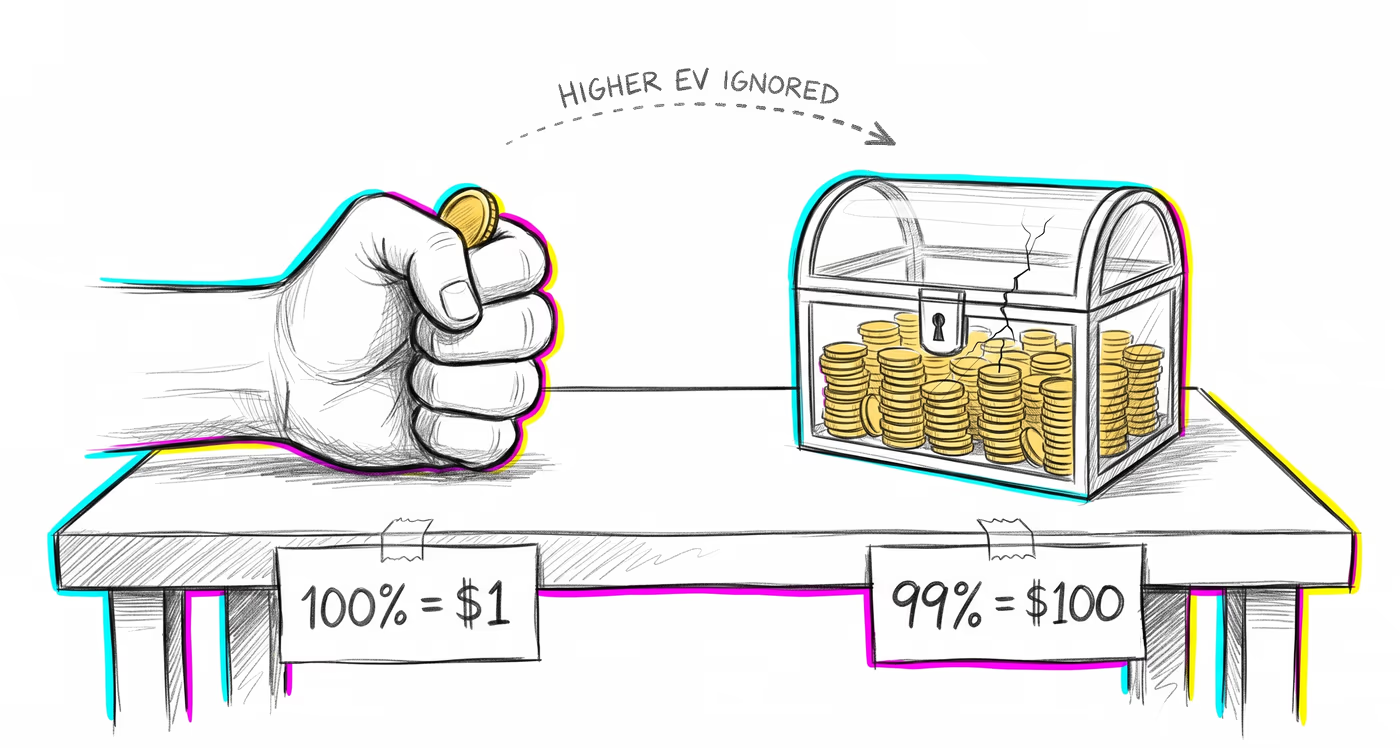
Overvaluing guaranteed outcomes over merely probable ones, even when the probable option is mathematically better.

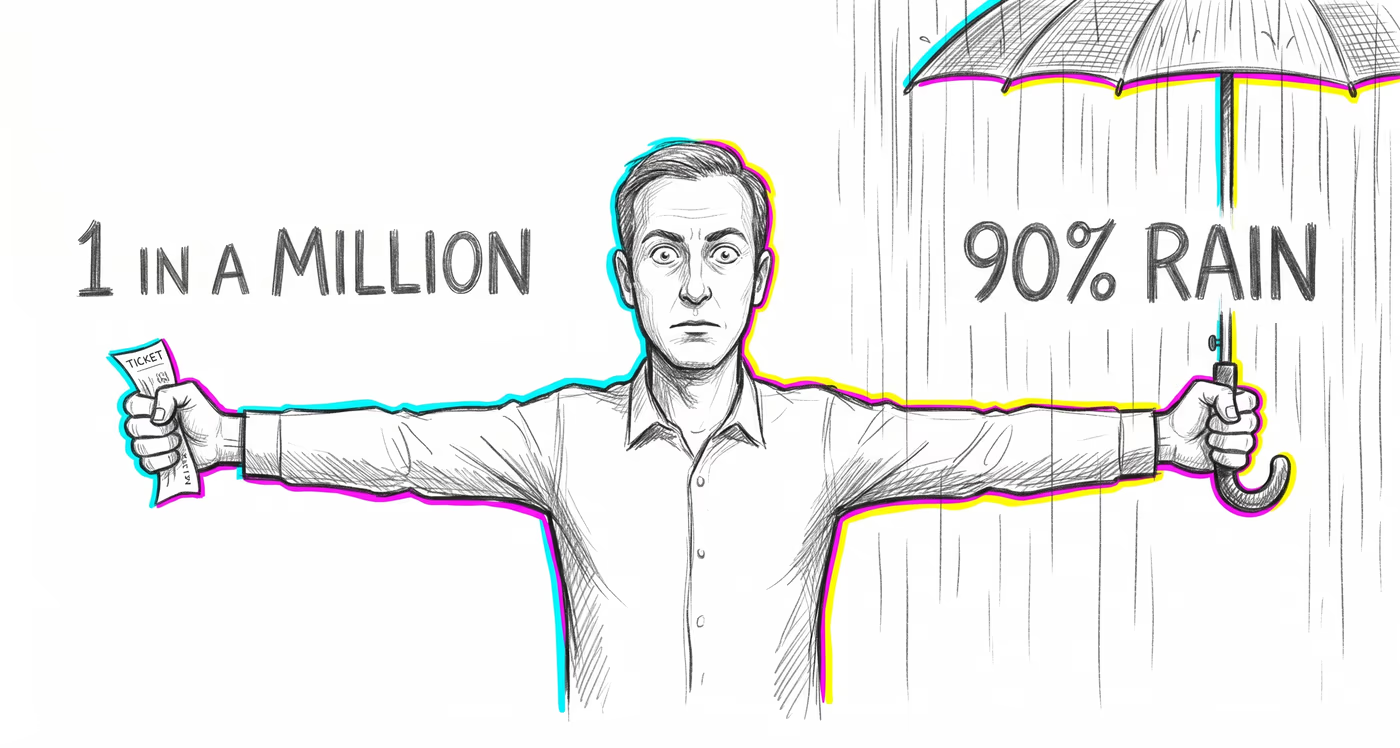
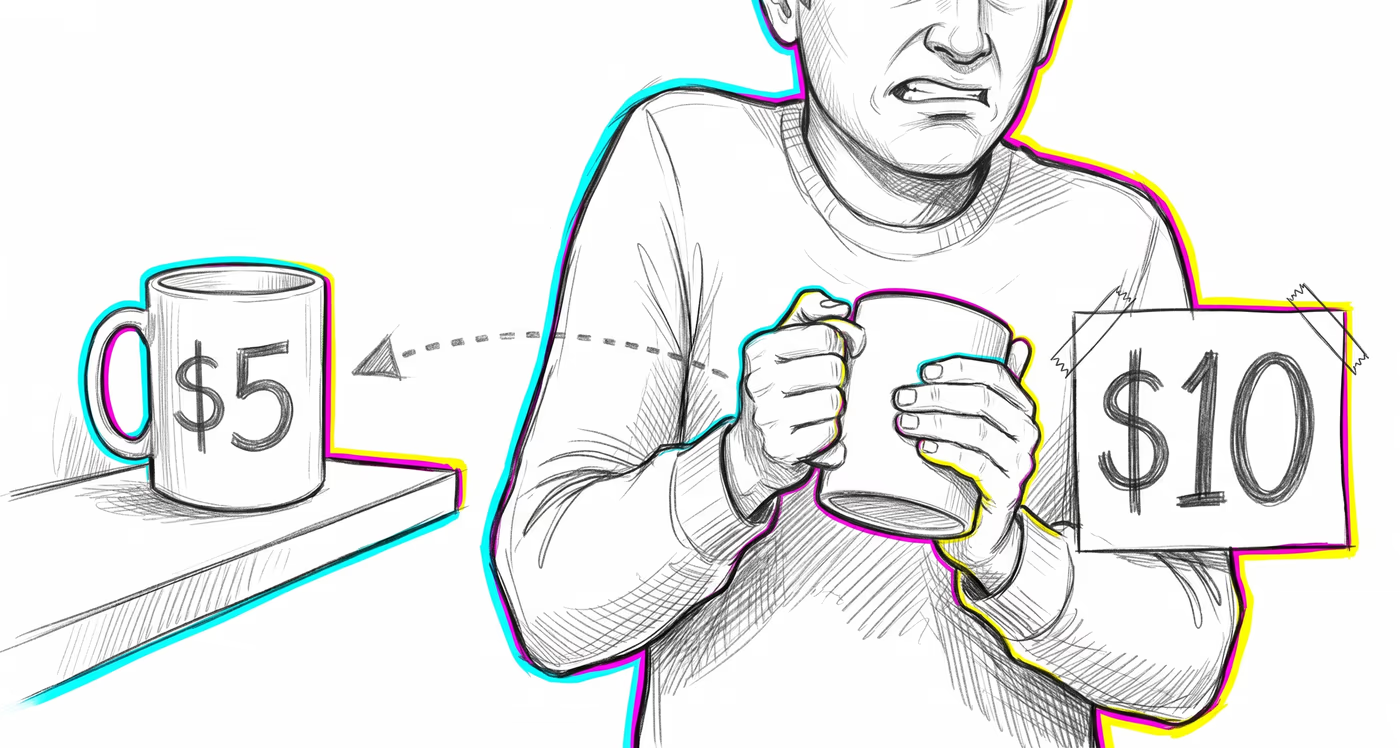
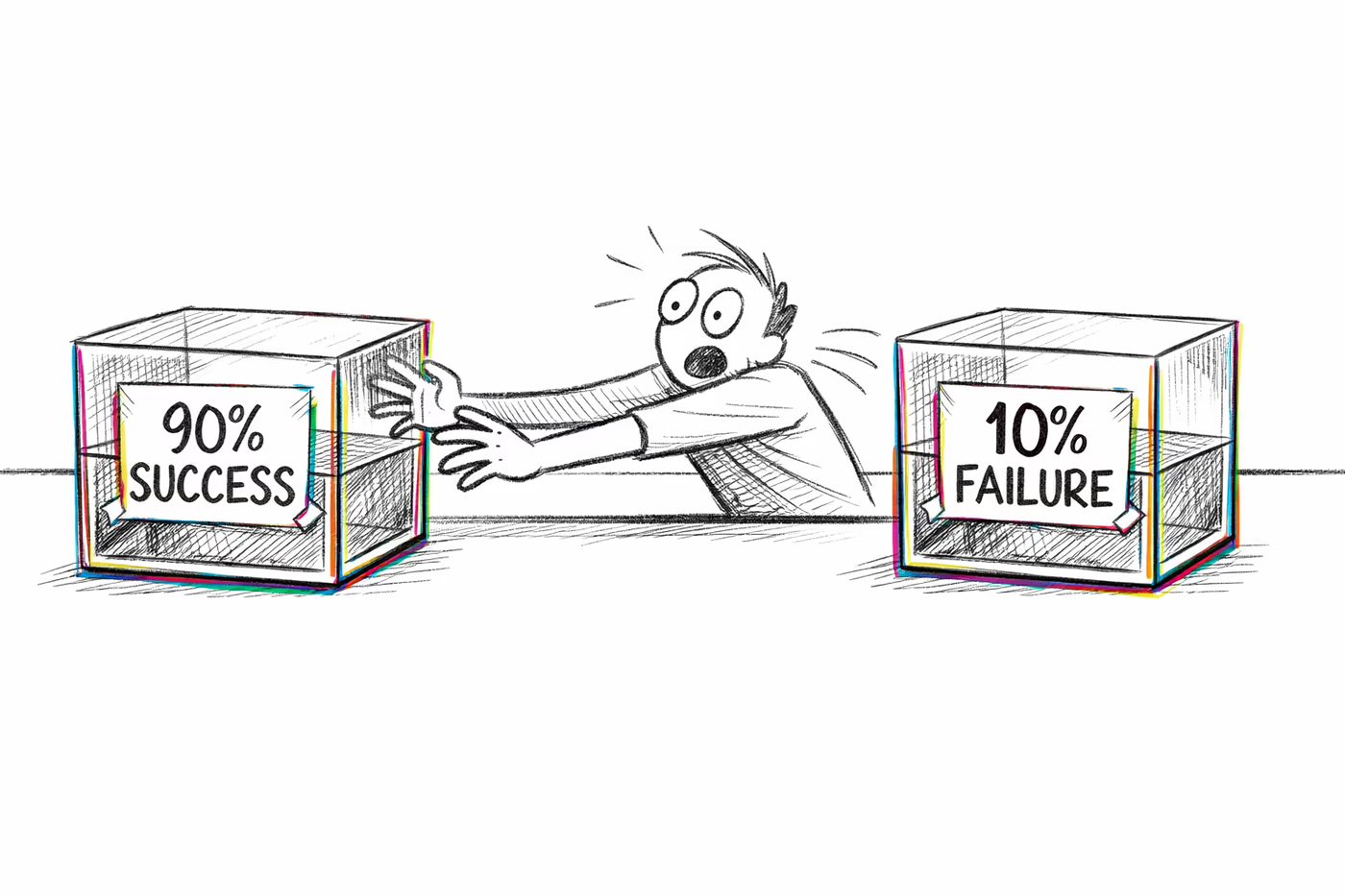
Illustration: Certainty Effect
WHAT IT IS

The glitch, explained plainly.

Imagine someone offers you one whole cookie right now, guaranteed, or a coin flip for three cookies. Most kids grab the one cookie even though the coin flip is a better deal on average. The moment something is a 'sure thing,' your brain treats it like it's way more valuable than something that's 'almost sure' — even if 'almost sure' is 99%.

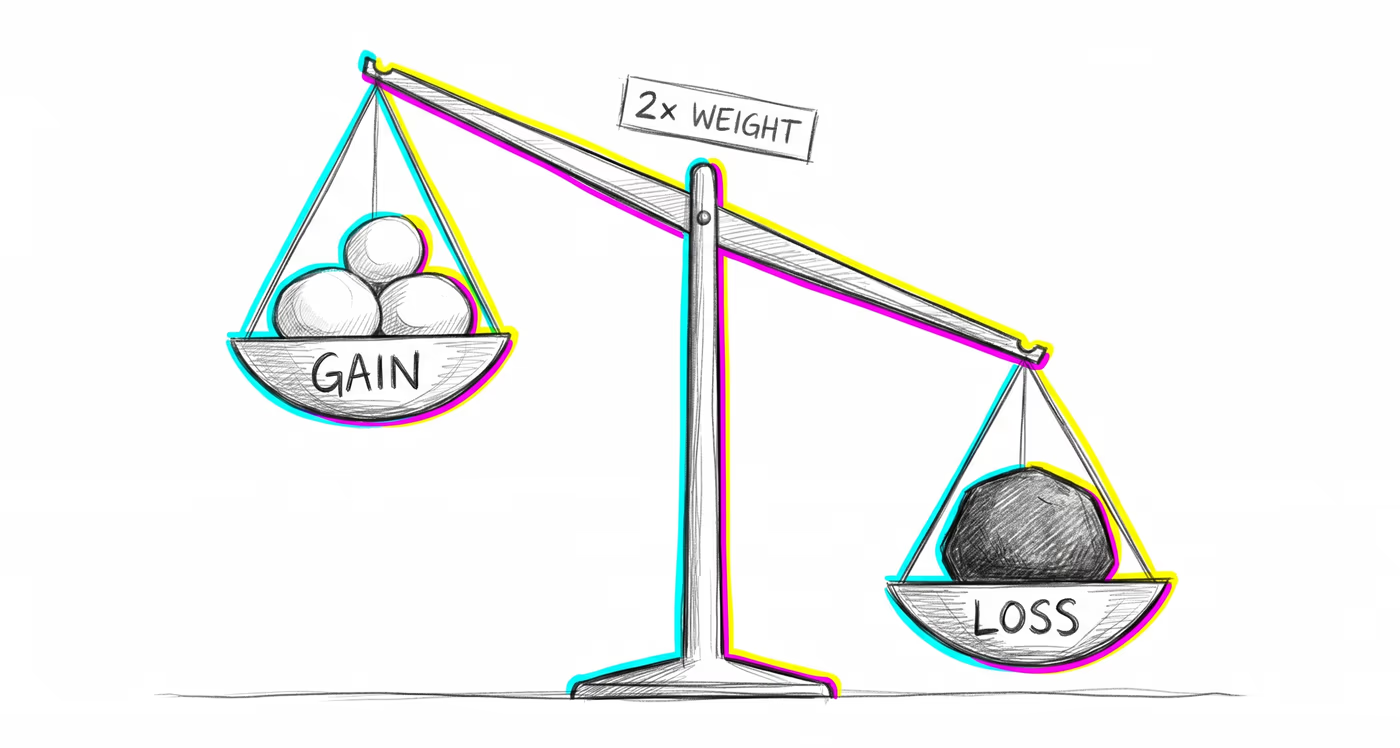
The certainty effect describes how the psychological jump between a 99% probability and a 100% probability feels vastly larger than the jump between, say, 50% and 51%, even though both represent the same one-percentage-point change. When facing gains, people become strongly risk-averse in the presence of a sure option, preferring a guaranteed smaller reward over a probabilistic larger one with higher expected value. Conversely, in the domain of losses, the effect reverses: people become risk-seeking to avoid a certain loss, preferring to gamble on the possibility of losing nothing even when the expected loss is greater. This asymmetric treatment of certainty versus near-certainty violates the independence axiom of expected utility theory and is a foundational component of Kahneman and Tversky's prospect theory.

SOUND FAMILIAR?

Where it shows up.

  1. 01 Maria is offered two bonus structures at work: Option A gives her a guaranteed $3,000 year-end bonus. Option B gives her an 80% chance of receiving $5,000 and a 20% chance of receiving nothing. Despite Option B having an expected value of $4,000, Maria immediately selects Option A, saying she'd rather have the money 'locked in.'
  2. 02 A pharmaceutical company presents two clinical trial results to a hospital board. Drug A cures a condition in 100% of patients but only partially (60% symptom reduction). Drug B cures 90% of patients completely (100% symptom reduction) and fails entirely for 10%. The board overwhelmingly selects Drug A, despite Drug B offering superior overall outcomes.
  3. 03 Carlos is choosing between two settlement offers in a lawsuit. His lawyer explains that Offer A is a guaranteed $200,000, while going to trial gives him a 95% chance of winning $250,000. Carlos takes the settlement, even though the expected value of the trial ($237,500) significantly exceeds it. He later rationalizes the decision by saying trials are unpredictable, but his lawyer notes the 5% risk doesn't justify forfeiting $37,500 in expected value.
  4. 04 A cybersecurity firm is choosing between two backup systems. System A guarantees recovery of 85% of data in any breach scenario. System B recovers 98% of data in 97% of breach scenarios but has a 3% chance of recovering only 50%. The firm picks System A despite its lower overall expected data recovery, because the IT director insists on 'knowing exactly what we'll get.'
  5. 05 A government must allocate disaster relief funds. Program A will definitively save 200 homes in a flood zone. Program B has a 90% chance of saving 280 homes but a 10% chance of saving none due to logistical complexity. Officials unanimously choose Program A. When the same officials are asked, in a separate framing, whether they'd prefer a plan that certainly loses 80 homes versus one with a 10% chance of losing all 280 homes, many now switch to the riskier option.
IN DIFFERENT DOMAINS

Where it shows up at work.

The same glitch looks different depending on the terrain. Finance, medicine, a relationship, a team — same mechanism, different costume.

Finance & investing

Investors disproportionately allocate to guaranteed-return instruments like bonds and CDs over higher-expected-value equities, and demand steep premium discounts for probabilistic insurance products that carry even a tiny residual risk of non-payout.
Medicine & diagnosis

Patients and clinicians systematically prefer treatments with certain but moderate outcomes over treatments with higher expected benefit but some probability of failure, leading to underuse of newer, probabilistically superior therapies.

Education & grading

Students tend to choose 'safe' essay prompts or familiar topics where they know they can secure a decent grade, rather than tackling more challenging questions with higher potential scores but less predictable outcomes.

Relationships

People stay in predictable but mediocre relationships because the outcome is 'known,' avoiding the uncertainty of dating someone new who might be much better — or much worse — for them.

Tech & product

Product designers exploit the certainty effect by framing pricing as 'guaranteed free shipping' rather than '99% of orders ship free,' and users disproportionately prefer subscription plans with fixed predictable costs over pay-per-use plans with lower expected cost.

Workplace & hiring

Employees accept lower guaranteed salaries over higher-expected-value compensation packages that include performance bonuses or equity, and managers choose safe, incremental projects over riskier innovations with greater expected returns.

Politics Media

Voters and policymakers favor programs that guarantee modest benefits to everyone over programs with higher expected aggregate benefit but some risk of failure, driving zero-risk regulatory mandates that are disproportionately expensive.

HOW TO SPOT IT

Ask yourself…

  • Am I choosing this option primarily because the outcome feels guaranteed, rather than because I've compared expected values?
  • Would I make the same choice if this option were 99% likely instead of 100%? If not, why does that 1% matter so much to me?
  • Am I conflating 'no uncertainty' with 'best outcome,' and have I actually calculated which option gives me more on average?
HOW TO DEFEND AGAINST IT

The playbook.

  • Explicitly calculate expected values for all options before choosing — write them down side by side to override emotional weighting.
  • Ask: 'If I had to make this same decision 100 times, which option would leave me better off overall?' This forces probabilistic thinking.
  • Reframe the certain option as its own gamble: a 100% chance of a smaller payoff is still a bet — just a conservative one.
  • Introduce a 'regret threshold' test: estimate how much you'd regret missing the higher-EV option versus how much comfort the guarantee truly provides.
  • Use pre-commitment: decide your strategy before seeing whether a certain option is available, so the presence of certainty doesn't distort your evaluation.
FAMOUS CASES

In history.

  • The Allais Paradox (1953): Economist Maurice Allais demonstrated that even professional economists systematically violated expected utility theory by preferring certain outcomes, kickstarting decades of research into non-rational decision-making.
  • Probabilistic insurance aversion: Wakker, Thaler, and Tversky (1997) showed that consumers demand more than a 20% premium discount to accept insurance with just a 1% residual chance of non-payout, demonstrating the certainty effect's impact on real insurance markets.
  • The Fukushima nuclear disaster aftermath: Following the 2011 disaster, several countries moved to completely phase out nuclear power (eliminating risk to zero) rather than accepting the statistically very low probability of future incidents, at enormous economic cost.
WHERE IT COMES FROM
Academic origin

Daniel Kahneman and Amos Tversky, 1979. The term 'certainty effect' was formally introduced in their foundational paper 'Prospect Theory: An Analysis of Decision under Risk' published in Econometrica. The underlying phenomenon was first demonstrated by Maurice Allais in 1953 (the Allais Paradox).

Evolutionary origin

In ancestral environments, certain outcomes (a guaranteed food source, a known safe shelter) had survival value that far exceeded probabilistic alternatives. A 95% chance of finding water at a distant oasis still carried a lethal 5% failure rate, so brains that heavily favored guaranteed resources over gambles — even slightly better gambles — were more likely to survive. This conservative bias toward sure things over uncertain prospects would have been adaptive in environments where a single bad outcome could mean death.

IN AI SYSTEMS

How the machines inherit it.

Recommendation systems and AI decision-support tools can amplify the certainty effect by displaying outcomes labeled as 'guaranteed' or '100% match' more prominently, causing users to overweight these options. In training, if reward functions penalize any uncertainty in outputs, models may learn to produce safe, low-variance responses rather than higher-expected-value outputs with slight variance — effectively baking the certainty effect into algorithmic behavior.

Read more on Wikipedia
FREE FIELD ZINE

10 glitches quietly running your life.

A free field-zine PDF — ten cognitive glitches named, illustrated, with a defense move for each. Plus the weekly Glitch Report on Fridays — one bias named, two spotted in the wild, one defense move. Unsubscribe any time.

EXPLORE MORE

Related glitches.

LAUNCH PRICE

Train against your blindspots.

50 cards are free to preview. Buyers unlock the rest of the deck plus the interactive training — Spot-the-Bias Quiz unlimited, Swipe Deck with spaced repetition, My Blindspots, Decision Pre-Flight, the Printable Deck + Cheat Sheets, and the Field Guide e-book. $29.50$59.

Unlock the full deck

Everything below — yours forever. Pay once, use across every device.

Half-off launch — limited to the first 100 readers. Auto-applied at checkout.
$59 $29.50
one-time payment · lifetime access
  • All interactive digital cards — search, filter, flip, shuffle on any device
  • Five training modes — Spot-the-Bias Quiz, Swipe Deck, Pre-Flight, Blindspots, Journal
  • Curated Lenses + Decision Templates + Defense Playbook
  • Printable Deck PDFs + Field Guide e-book + Cheat Sheets + Anki Export
  • Every future improvement, included
Unlock  $29.50

30-day refund · no questions asked

Unlock the full deck

Everything below — yours forever. Pay once, use across every device.

Half-off launch — limited to the first 100 readers. Auto-applied at checkout.
$59 $29.50
one-time payment · lifetime access
  • All interactive digital cards — search, filter, flip, shuffle on any device
  • Five training modes — Spot-the-Bias Quiz, Swipe Deck, Pre-Flight, Blindspots, Journal
  • Curated Lenses + Decision Templates + Defense Playbook
  • Printable Deck PDFs + Field Guide e-book + Cheat Sheets + Anki Export
  • Every future improvement, included
Unlock  $29.50

30-day refund · no questions asked