Intention-Action Gap

aka Resolution Bias · Intention-Behavior Gap · Value-Action Gap

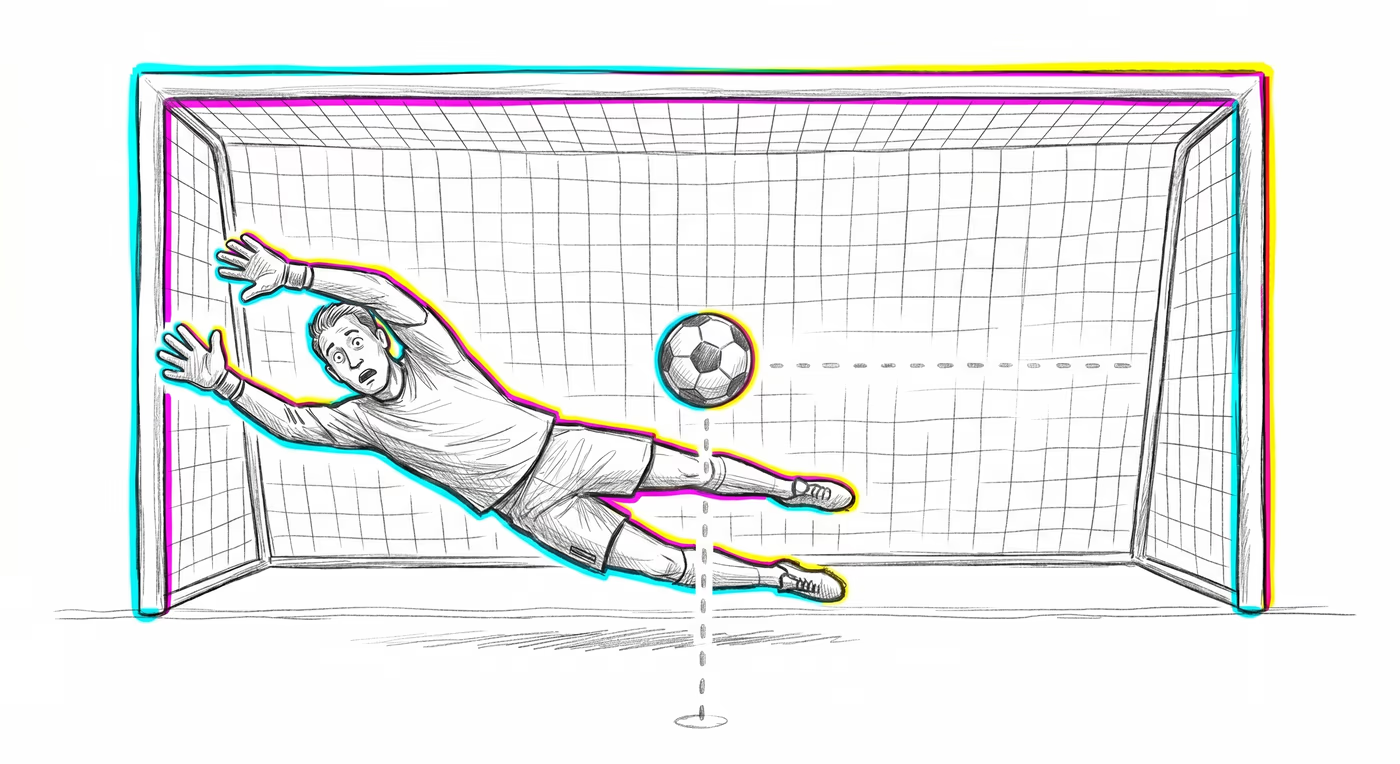
The reliable gap between what people intend to do and what they actually do — resolutions consistently failing to become actions.

WHAT IT IS

The glitch, explained plainly.

Imagine you really want to clean your messy room. You stand up, put your hands on your hips, and say 'I'm going to clean this room RIGHT NOW!' That feels so good and powerful that you sit back down and watch TV instead, because saying it already made you feel like you did something.

Resolution Bias captures the systematic overvaluation of the moment of commitment itself — the declaration, the promise, the written goal — as though the psychological intensity of resolving to change were evidence that change has already begun. People experiencing this bias derive premature satisfaction from the act of deciding, which paradoxically depletes the motivational energy needed for execution. The bias is amplified by social reinforcement: announcing a goal publicly can trigger identity-level satisfaction before any behavioral work has been done. This creates a dangerous feedback loop where the emotional reward of resolving replaces the reward of achieving, and repeated resolution-making becomes a substitute for actual progress.

SOUND FAMILIAR?

Where it shows up.

  1. 01 Maya spends an entire Sunday afternoon writing a comprehensive study schedule for the rest of the semester, color-coding subjects and allocating specific time blocks. She posts it above her desk, feels a deep sense of relief and control, and then spends the next three weeks studying exactly the way she always has — sporadically and last-minute.
  2. 02 After a health scare, David tells his wife he has decided to completely overhaul his diet. He throws out all junk food, orders a set of glass meal-prep containers, and subscribes to a healthy recipe newsletter. Two weeks later, the containers are still in their packaging and he's eating takeout most nights, but he genuinely feels he's 'on the right track' because of that initial decisive action.
  3. 03 A startup founder opens a company all-hands meeting with a passionate speech about their new commitment to work-life balance, announcing flexible hours and wellness Fridays. Employees feel genuinely optimistic, and the founder feels like a progressive leader. Six months later, nothing has structurally changed — crunch culture persists — but the founder still references that speech as proof of the company's values.
  4. 04 A city council votes unanimously to declare a 'climate emergency' and pledges to achieve carbon neutrality by 2035. The resolution generates positive press coverage and public approval. When asked two years later about specific policy changes, officials point to the declaration itself as their primary achievement, even though no binding legislation or infrastructure changes have followed.
  5. 05 A product manager sends a long email to the engineering team outlining a new commitment to reducing technical debt, complete with principles and a philosophical rationale. The team applauds the email. Quarterly planning continues to prioritize new features exactly as before, but the product manager feels the problem has been meaningfully addressed because the intention was clearly articulated.
IN DIFFERENT DOMAINS

Where it shows up at work.

The same glitch looks different depending on the terrain. Finance, medicine, a relationship, a team — same mechanism, different costume.

Finance & investing

Investors who create elaborate financial plans or set annual savings targets derive a false sense of financial security from the plan itself, often failing to adjust spending behavior to match. The act of budgeting substitutes for the discipline of budgeting.


Medicine & diagnosis

Patients who receive a diagnosis and resolve to 'take better care of themselves' often report high confidence in their lifestyle change immediately after the doctor's visit, but revert to baseline behavior within weeks. Clinicians may mistake a patient's verbal commitment for actual adherence likelihood.

Education & grading

Students who set ambitious academic goals at the start of a semester — declaring GPAs, study schedules, or reading targets — often experience a motivational crash shortly after, because the goal-setting itself consumed the energy that should have fueled execution.

Relationships

Partners who have a serious conversation about improving communication or spending more quality time together often feel the relationship has improved simply because the conversation happened, without following through on the specific behavioral changes discussed.

Tech & product

Product teams that hold retrospectives and commit to process improvements after incidents often treat the retrospective document itself as the fix, rarely implementing the action items. Users who download productivity apps feel more productive from the act of installing them alone.

Workplace & hiring

Organizations that announce diversity initiatives, values statements, or cultural commitments often experience 'announcement fatigue' — leadership treats the public commitment as equivalent to structural reform, while employees grow cynical as no tangible changes follow.

Politics Media

Politicians and institutions frequently issue declarations, pledges, and resolutions on pressing issues — climate change, inequality, public safety — deriving political capital from the announcement itself. Media coverage of the resolution substitutes for coverage of implementation, enabling a cycle where symbolic commitments replace policy action.

HOW TO SPOT IT

Ask yourself…

  • Am I feeling satisfied or relieved right now simply because I stated a goal, even though I haven't taken any concrete action toward it yet?
  • Have I made this same resolution before without following through — and am I treating this new declaration as fundamentally different without changing my approach?
  • Would I still feel motivated to act if no one else knew about my commitment, or is the social announcement itself the reward?
HOW TO DEFEND AGAINST IT

The playbook.

  • Apply the 'Two-Minute Rule': immediately after making a resolution, take one concrete action — no matter how small — within two minutes to break the intention-action gap.
  • Ban announcement without action: adopt a personal policy of not telling anyone about a goal until you have at least one week of behavioral evidence.
  • Replace outcome resolutions with process commitments: instead of 'I will lose 20 pounds,' commit to 'I will walk for 15 minutes every morning this week.'
  • Schedule implementation reviews: set calendar reminders at regular intervals that ask not 'What did I resolve?' but 'What did I actually do?'
  • Practice resolution skepticism: when you feel the rush of commitment, explicitly ask yourself 'What specifically will be different tomorrow morning because of this resolution?'
FAMOUS CASES

In history.

  • The pattern of failed New Year's resolutions, consistently documented since the 1980s, with research showing approximately 80% abandonment by mid-February, illustrates how the cultural ritual of resolving has become systematically decoupled from behavioral follow-through.
  • Corporate and governmental climate pledges (e.g., various net-zero by 2050 commitments) have been criticized by analysts for functioning as resolution bias at an institutional scale — where the declaration of ambitious targets substitutes for near-term binding policy changes.
WHERE IT COMES FROM
Academic origin

The intention-behavior gap has been studied extensively in health psychology and behavioral science. Paschal Sheeran (2002) published a landmark meta-analysis in the British Journal of Social Psychology quantifying the gap. Gollwitzer (1999) proposed implementation intentions as a solution. The broader concept draws on the theory of planned behavior (Ajzen, 1991).

Evolutionary origin

In ancestral environments, the ability to form and communicate clear intentions was itself a survival advantage — signaling to group members that you would participate in a hunt or defend the camp generated social trust and cooperation. The brain therefore evolved to reward intention-formation as a meaningful behavioral step, since in small-group contexts, stating an intention usually preceded immediate action with high fidelity. The gap between intention and action was narrow in environments with constant social accountability and immediate consequences.

IN AI SYSTEMS

How the machines inherit it.

AI systems can reinforce resolution bias by making it frictionless to generate plans, schedules, and goals without providing accountability structures. AI-powered productivity tools that help users create elaborate goal frameworks may inadvertently increase the reward signal for planning while doing nothing to close the intention-action gap. Additionally, AI assistants that affirm users' stated intentions without tracking follow-through can enable cycles of unproductive resolution-making.

FREE FIELD ZINE

10 glitches quietly running your life.

A free field-zine PDF — ten cognitive glitches named, illustrated, with a defense move for each. Plus the weekly Glitch Report on Fridays — one bias named, two spotted in the wild, one defense move. Unsubscribe any time.

EXPLORE MORE

Related glitches.

LAUNCH PRICE

Train against your blindspots.

50 cards are free to preview. Buyers unlock the rest of the deck plus the interactive training — Spot-the-Bias Quiz unlimited, Swipe Deck with spaced repetition, My Blindspots, Decision Pre-Flight, the Printable Deck + Cheat Sheets, and the Field Guide e-book. $29.50$59.

Unlock the full deck

Everything below — yours forever. Pay once, use across every device.

Half-off launch — limited to the first 100 readers. Auto-applied at checkout.
$59 $29.50
one-time payment · lifetime access
  • All interactive digital cards — search, filter, flip, shuffle on any device
  • Five training modes — Spot-the-Bias Quiz, Swipe Deck, Pre-Flight, Blindspots, Journal
  • Curated Lenses + Decision Templates + Defense Playbook
  • Printable Deck PDFs + Field Guide e-book + Cheat Sheets + Anki Export
  • Every future improvement, included
Unlock  $29.50

30-day refund · no questions asked

Unlock the full deck

Everything below — yours forever. Pay once, use across every device.

Half-off launch — limited to the first 100 readers. Auto-applied at checkout.
$59 $29.50
one-time payment · lifetime access
  • All interactive digital cards — search, filter, flip, shuffle on any device
  • Five training modes — Spot-the-Bias Quiz, Swipe Deck, Pre-Flight, Blindspots, Journal
  • Curated Lenses + Decision Templates + Defense Playbook
  • Printable Deck PDFs + Field Guide e-book + Cheat Sheets + Anki Export
  • Every future improvement, included
Unlock  $29.50

30-day refund · no questions asked