Positivity Effect

aka Age-Related Positivity Bias · Positivity Bias in Aging

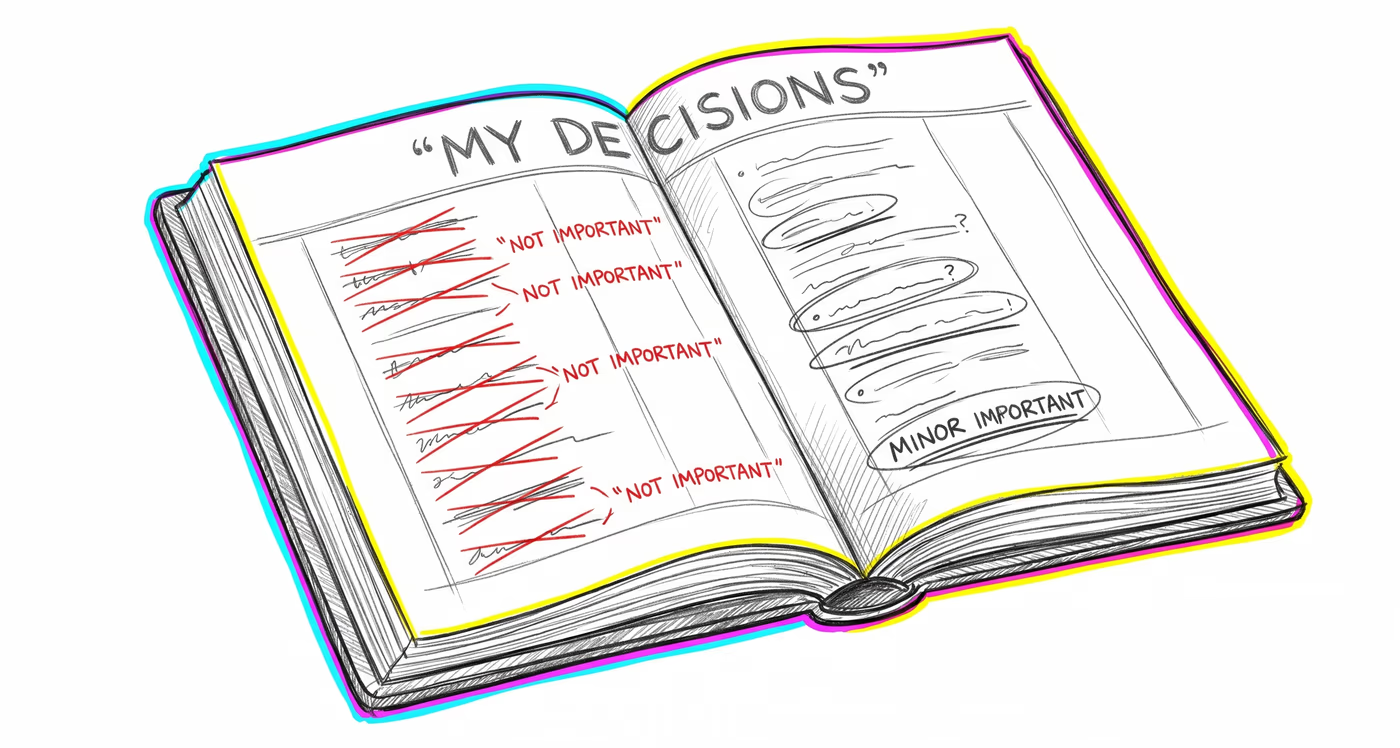
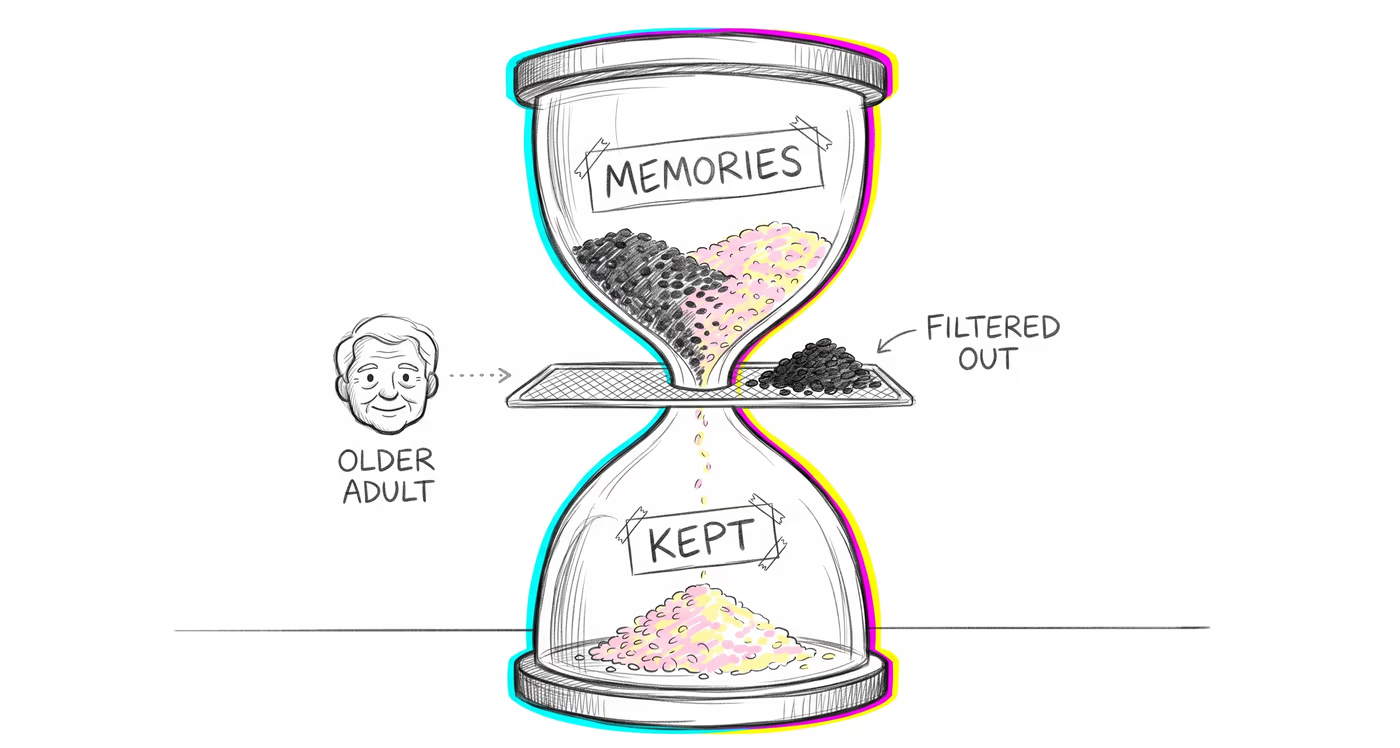
Older adults preferentially noticing, processing, and remembering positive information over negative information.

Illustration: Positivity Effect
WHAT IT IS

The glitch, explained plainly.

Imagine you and your grandparent both watch the same movie that has happy parts and sad parts. You'd probably remember the scary villain and the sad ending really well. But your grandparent would come away mostly remembering the happy wedding scene and the funny jokes. It's like as people get older, their brain puts on sunshine-colored glasses that make the bright parts stand out more and let the dark parts fade into the background.

The Positivity Effect describes a robust developmental shift in how people process emotional information across the lifespan. While younger adults and children show a pronounced negativity bias — preferentially detecting, attending to, and remembering threatening or negative stimuli — this tendency gradually reverses with age, such that older adults disproportionately favor positive over negative material in both attention and memory. Importantly, this is not a product of cognitive decline; research shows the effect is strongest in older adults with intact executive functioning and disappears under cognitive load or in conditions like Alzheimer's disease. The effect manifests across multiple cognitive domains including visual attention (measured through eye-tracking), episodic and autobiographical memory, decision-making, and responses to persuasive messaging.

SOUND FAMILIAR?

Where it shows up.

  1. 01 A 72-year-old woman and her 28-year-old granddaughter both attend a family reunion where some relatives are warm and welcoming while others make rude, passive-aggressive comments. A week later, the grandmother mostly recalls the warm hugs and laughter, while the granddaughter can vividly recount every snide remark made during the event.
  2. 02 A researcher shows a series of happy, sad, and neutral photographs to two groups: college students and retirees in their 70s. On a surprise memory test, the retirees recall significantly more happy images and fewer sad images than the students, who show the reverse pattern. The retirees have no cognitive impairment and score normally on executive function tests.
  3. 03 A 68-year-old man reads reviews for a financial product. Several reviews are glowing while a few warn about hidden fees and poor customer service. He decides to invest, primarily recalling the positive testimonials. His 35-year-old colleague, reading the same reviews, fixates on the negative warnings and decides against investing.
  4. 04 A hospital designs two brochures about a recommended surgery: one emphasizes the benefits and recovery success stories, the other outlines risks and complications. The older patients remember the benefits brochure far better and report higher satisfaction with their decision, while the younger patients recall more details from the risk brochure. Both groups read both brochures for the same amount of time.
  5. 05 A psychologist uses eye-tracking software and finds that older participants with strong executive function consistently shift their gaze toward smiling faces and away from angry faces in paired displays, whereas younger adults show no such preference or slightly favor the angry faces. When the older participants are given a demanding secondary task that taxes their working memory, this gaze preference disappears entirely.
IN DIFFERENT DOMAINS

Where it shows up at work.

The same glitch looks different depending on the terrain. Finance, medicine, a relationship, a team — same mechanism, different costume.

Finance & investing

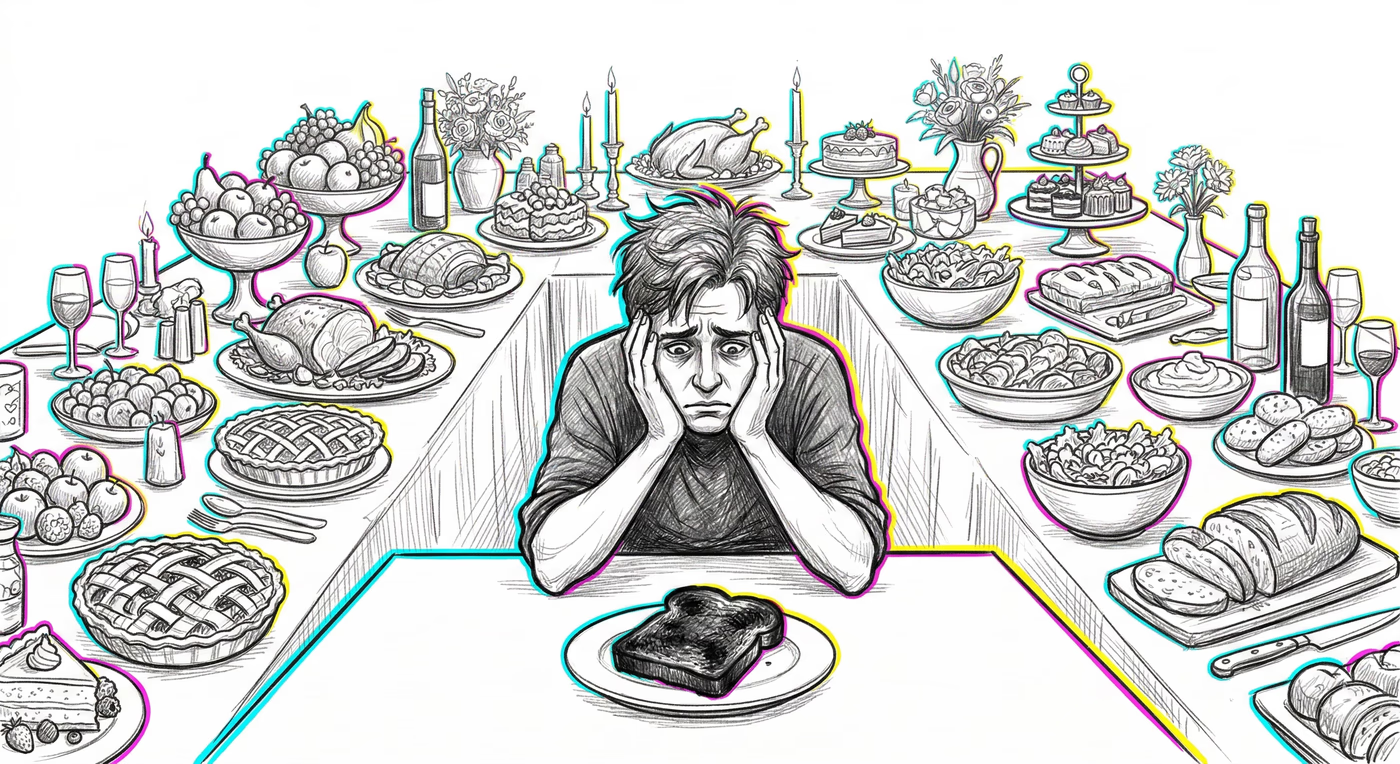
Older investors tend to disproportionately attend to and remember positive information about investments — gains, success stories, and optimistic projections — while underweighting risks, fees, and negative performance data. This pattern increases their vulnerability to financial scams and overly rosy sales pitches.
Medicine & diagnosis

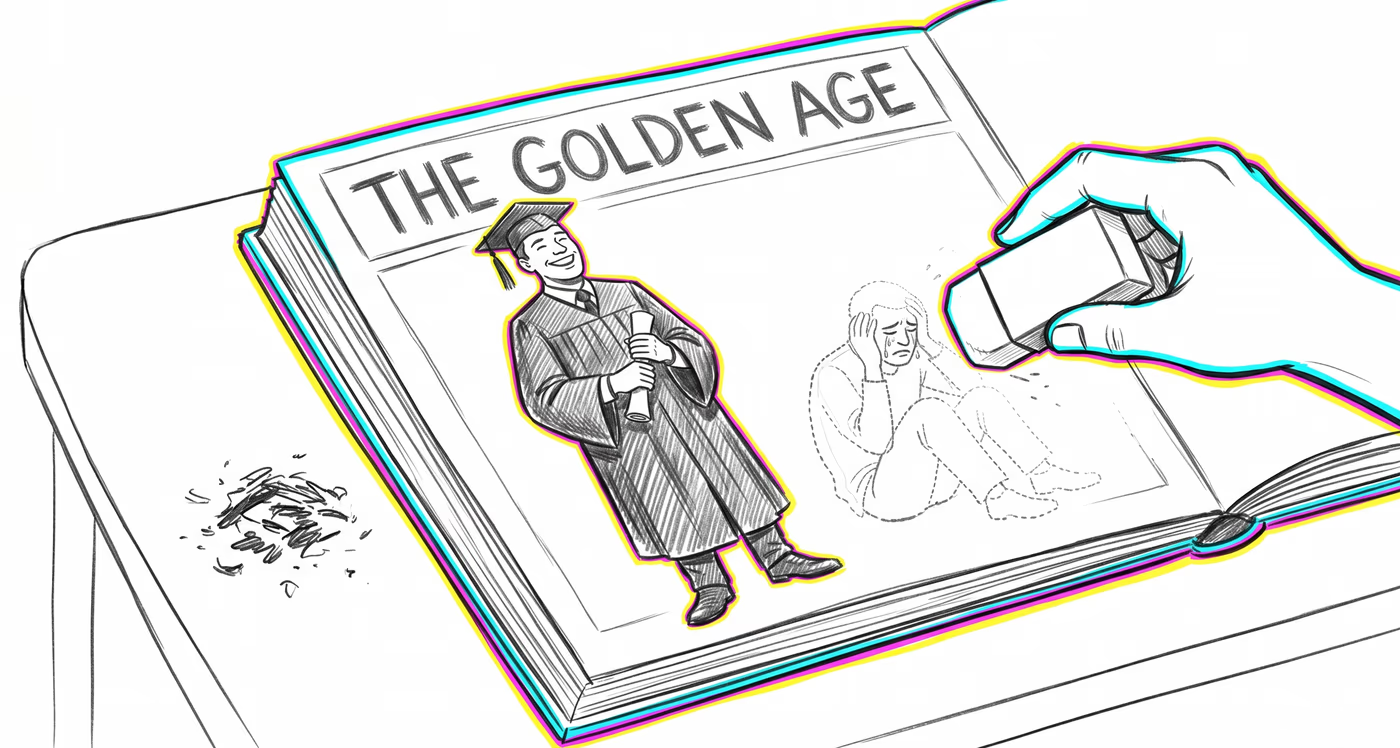
Older patients tend to better recall the benefits and success rates of treatments while underweighting information about side effects and complications. Health messaging framed positively (e.g., survival rates) tends to be more effective with older adults than negatively framed equivalents (e.g., mortality rates).

Education & grading

Older adult learners tend to retain positively framed educational content more effectively than cautionary or fear-based material. Instructional approaches that leverage positive examples and success-oriented framing tend to be more effective with mature learners than threat-based motivation.

Relationships

Older adults tend to recall their past relationships — including marriages and friendships — in a more favorable light than younger adults would. They emphasize joyful memories and minimize recollection of conflicts, which may contribute to greater relationship satisfaction in later life but can also create friction when reminiscing with younger family members who recall events differently.

Tech & product

Interfaces and communications designed for older users are more effective when they emphasize positive outcomes (e.g., 'Stay connected with family') rather than loss prevention ('Don't miss important updates'). Older adults are also more likely to overlook negative user reviews or warning messages in product interfaces.

Workplace & hiring

Older employees and retirees tend to recall their career experiences more positively than they may have reported at the time, emphasizing accomplishments and camaraderie over workplace stress and conflict. Retirement satisfaction surveys may be inflated by this effect.

Politics Media

Older voters tend to be more responsive to positively framed political messages that emphasize hope and community benefit, and less influenced by fear-based or negative campaign advertising compared to younger voters. However, this can also make them more susceptible to scams disguised as optimistic pitches.

HOW TO SPOT IT

Ask yourself…

  • Am I remembering mostly the good parts of a past experience while the negative parts feel hazy or unimportant?
  • Am I giving more weight to the positive aspects of a decision while dismissing warnings or downsides that a younger person might take seriously?
  • Have I noticed that my recollection of an event is significantly rosier than what others who were there describe?
HOW TO DEFEND AGAINST IT

The playbook.

  • When making important decisions, deliberately force yourself to write down both pros and cons, giving equal time to negative information before deciding.
  • Ask a younger trusted person to review the same information and compare their takeaways with yours — systematic differences may reveal the bias at work.
  • When recalling important past events, check your memories against records, photos, or accounts from others before drawing conclusions.
  • For high-stakes decisions like finances or health, adopt structured decision-making frameworks that require explicit evaluation of risks and downsides.
  • Practice the 'premortem' technique: before finalizing a decision, imagine it went badly and force yourself to articulate why.
WHERE IT COMES FROM
Academic origin

Coined by Laura L. Carstensen's research group at Stanford University, building on work by Charles, Mather, and Carstensen (2003) and formally articulated by Mather and Carstensen (2005) within the framework of Socioemotional Selectivity Theory (SST), originally proposed by Carstensen in 1992.

Evolutionary origin

The negativity bias in youth served clear survival functions — detecting threats, learning from dangers, and avoiding harm during the exploratory and reproductive phases of life. The shift toward positivity in later life may have conferred inclusive fitness advantages: older adults who focused on emotional satisfaction and meaningful social bonds would have been more effective caregivers and knowledge transmitters for kin, thereby increasing the survival odds of grandchildren and promoting group cohesion.

IN AI SYSTEMS

How the machines inherit it.

Training data derived disproportionately from younger users may embed a negativity bias in sentiment analysis models and content recommendation algorithms, causing them to under-represent or misclassify the emotional processing patterns of older adults. Conversely, models trained heavily on older adult data could underweight genuinely important negative signals. Age-biased training corpora may also generate overly negative or overly positive content depending on the demographic composition of the data.

Read more on Wikipedia
FREE FIELD ZINE

10 glitches quietly running your life.

A free field-zine PDF — ten cognitive glitches named, illustrated, with a defense move for each. Plus the weekly Glitch Report on Fridays — one bias named, two spotted in the wild, one defense move. Unsubscribe any time.

EXPLORE MORE

Related glitches.

LAUNCH PRICE

Train against your blindspots.

50 cards are free to preview. Buyers unlock the rest of the deck plus the interactive training — Spot-the-Bias Quiz unlimited, Swipe Deck with spaced repetition, My Blindspots, Decision Pre-Flight, the Printable Deck + Cheat Sheets, and the Field Guide e-book. $29.50$59.

Unlock the full deck

Everything below — yours forever. Pay once, use across every device.

Half-off launch — limited to the first 100 readers. Auto-applied at checkout.
$59 $29.50
one-time payment · lifetime access
  • All interactive digital cards — search, filter, flip, shuffle on any device
  • Five training modes — Spot-the-Bias Quiz, Swipe Deck, Pre-Flight, Blindspots, Journal
  • Curated Lenses + Decision Templates + Defense Playbook
  • Printable Deck PDFs + Field Guide e-book + Cheat Sheets + Anki Export
  • Every future improvement, included
Unlock  $29.50

30-day refund · no questions asked

Unlock the full deck

Everything below — yours forever. Pay once, use across every device.

Half-off launch — limited to the first 100 readers. Auto-applied at checkout.
$59 $29.50
one-time payment · lifetime access
  • All interactive digital cards — search, filter, flip, shuffle on any device
  • Five training modes — Spot-the-Bias Quiz, Swipe Deck, Pre-Flight, Blindspots, Journal
  • Curated Lenses + Decision Templates + Defense Playbook
  • Printable Deck PDFs + Field Guide e-book + Cheat Sheets + Anki Export
  • Every future improvement, included
Unlock  $29.50

30-day refund · no questions asked