Social Proof

aka Social Proof · Informational Social Influence · Consensus Heuristic

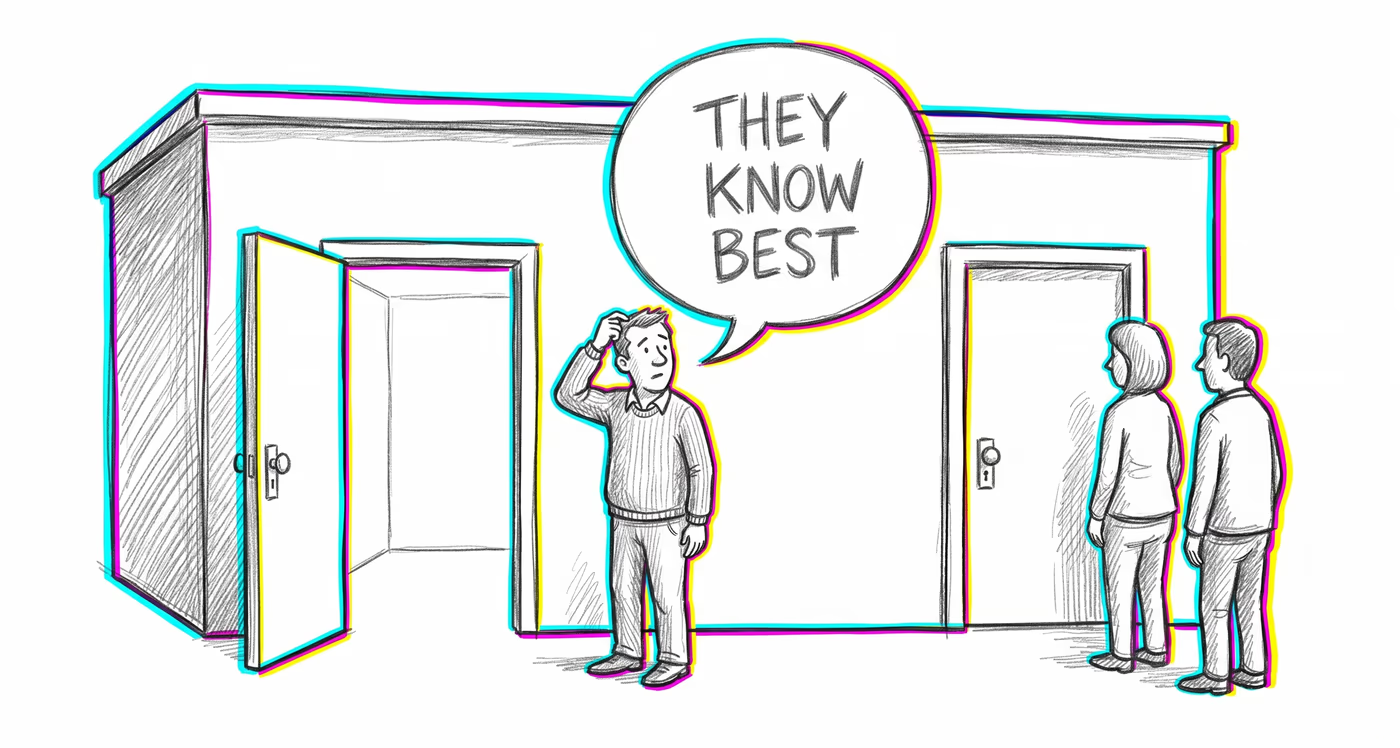
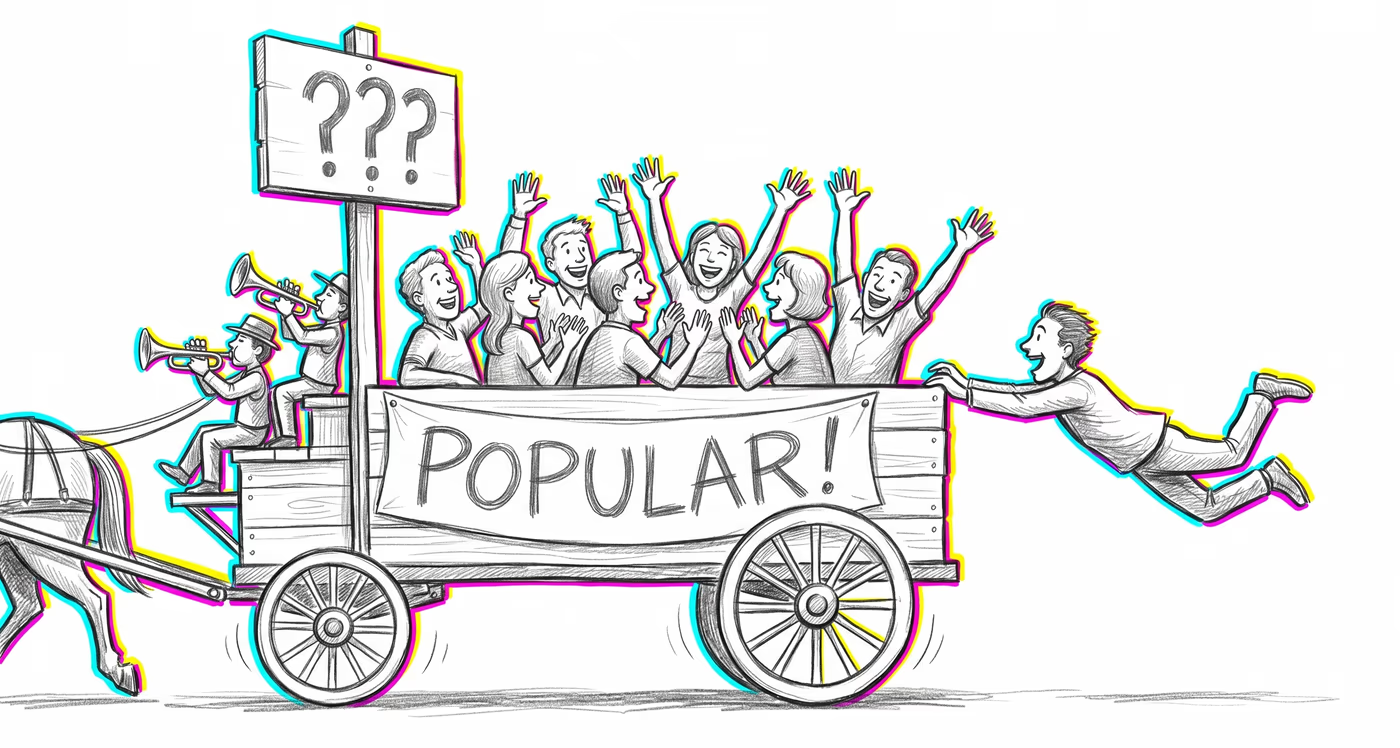
Deciding what to do by watching what others are doing, especially in uncertain situations — assuming the crowd knows best.

Illustration: Social Proof
WHAT IT IS

The glitch, explained plainly.

Imagine you're in a new town and you see two ice cream shops: one is empty and one has a long line. You'd probably get in the long line, thinking 'all those people must know something I don't.' You didn't taste either shop's ice cream—you just copied what the crowd was doing because you figured they already did the research for you.

The social proof heuristic is a mental shortcut in which individuals outsource their judgment to the observed behavior of a group, particularly when personal knowledge is insufficient to evaluate the situation independently. Unlike normative conformity, where people go along to be liked or accepted, social proof operates through informational influence—people genuinely believe the crowd possesses superior knowledge. The effect is amplified under conditions of uncertainty, when the observed group members are perceived as similar to oneself, and when the group is large. While often adaptive—popular restaurants usually do serve good food—the heuristic can cause rapid, poorly grounded convergence on a single choice, producing information cascades where millions of people may be following a signal based on very little original evidence.

SOUND FAMILIAR?

Where it shows up.

  1. 01 Choosing the restaurant with a line out the door over the empty one next door, even knowing nothing about either menu.
  2. 02 Laughing at a joke that wasn't funny because everyone else in the room is laughing.
IN DIFFERENT DOMAINS

Where it shows up at work.

The same glitch looks different depending on the terrain. Finance, medicine, a relationship, a team — same mechanism, different costume.

Finance & investing

Investors pile into assets, sectors, or strategies primarily because they observe other market participants doing so, creating momentum-driven bubbles. The appearance of consensus among institutional investors is often mistaken for independent fundamental analysis, accelerating herd-driven booms and crashes.
Medicine & diagnosis

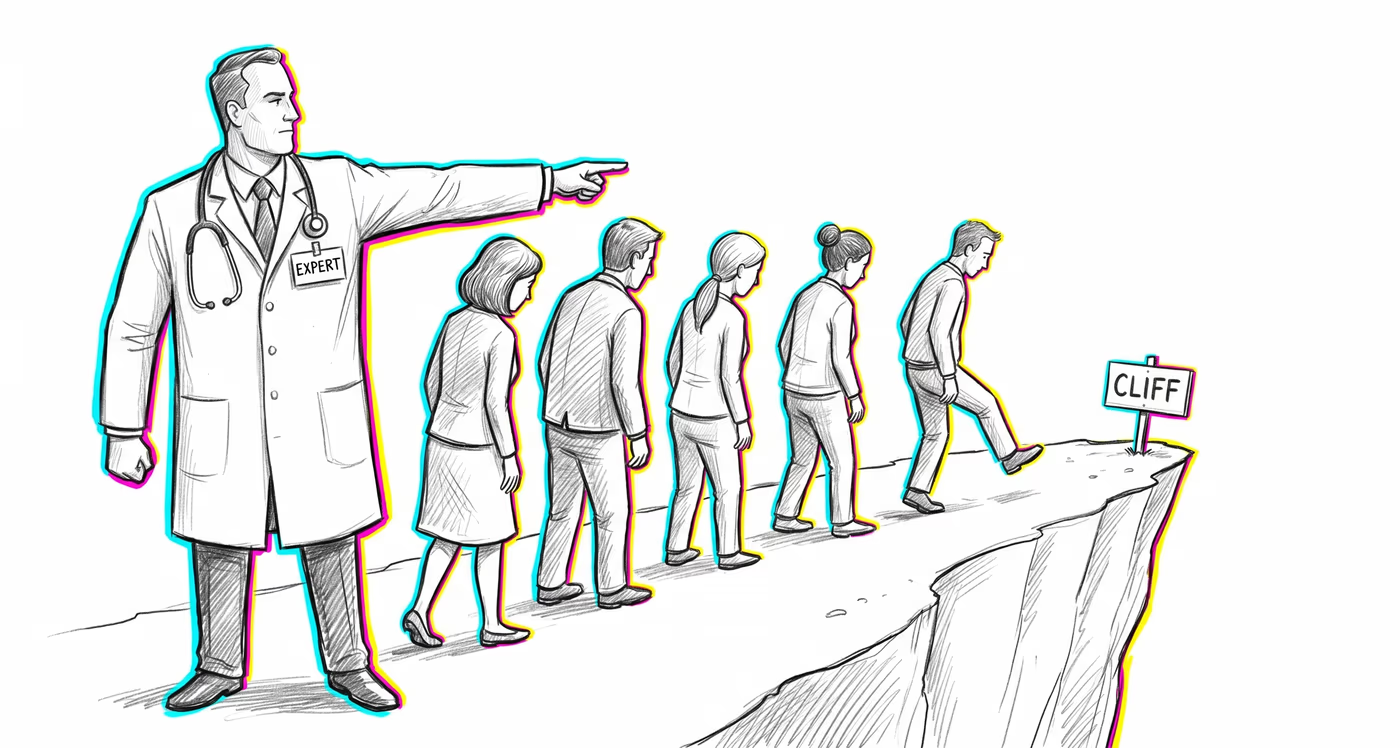
Clinicians may over-rely on prevailing treatment protocols or majority diagnostic opinions rather than independently evaluating atypical patient presentations. Patients, meanwhile, choose doctors, treatments, or hospitals based on popularity metrics and volume of reviews rather than outcome data.

HOW TO SPOT IT

Ask yourself…

  • Am I choosing this primarily because I see many other people choosing it, rather than based on my own independent evaluation?
  • If I were the only person making this decision with no knowledge of what others had chosen, would I still arrive at the same conclusion?
HOW TO DEFEND AGAINST IT

The playbook.

  • Conduct at least one independent evaluation before checking what others have chosen — form your own opinion first, then consult social signals.
  • Ask 'what is the original evidence?' behind the crowd's choice. Try to trace whether the consensus is based on independent assessments or a cascade of copying.
FAMOUS CASES

In history.

  • The Dutch Tulip Mania (1636–1637), where escalating prices were driven largely by the observation that everyone else was buying tulips, creating a speculative bubble that collapsed catastrophically.
  • The 2008 financial crisis, in which financial institutions engaged in risky mortgage-backed securities partly because the widespread adoption of these instruments by major banks was interpreted as validation of their safety.
  • The Jonestown mass suicide (1978), where social proof dynamics within an isolated community contributed to over 900 people following the group's action of consuming poison.
  • Bank runs throughout history, such as the 1930s Great Depression runs, where people withdrew their savings primarily because they saw others doing so, creating self-fulfilling institutional collapses.
WHERE IT COMES FROM
Academic origin

Robert Cialdini coined the term 'social proof' as a principle of influence in his 1984 book 'Influence: Science and Practice.' The underlying phenomenon of informational social influence was empirically demonstrated earlier by Muzafer Sherif in his 1935 autokinetic effect experiments and further explored in Solomon Asch's 1951 conformity line experiments.

Evolutionary origin

In ancestral environments, copying the behavior of the majority was a low-cost survival strategy. If others were running from a location, the individual who paused to independently assess the threat was more likely to be killed by the predator. Following the group to food sources, water, and safe shelter transmitted survival-relevant information across generations without requiring each individual to learn through dangerous personal experience.

IN AI SYSTEMS

How the machines inherit it.

Recommendation algorithms amplify social proof by surfacing content, products, or opinions that are already popular, creating feedback loops where early engagement snowballs into dominance regardless of quality. AI systems trained on engagement data learn to optimize for viral, consensus-driven content, and platforms use algorithmic social proof (trending lists, 'popular near you') that can be gamed by bots and coordinated manipulation campaigns, making artificial consensus indistinguishable from genuine popularity.

Read more on Wikipedia
FREE FIELD ZINE

10 glitches quietly running your life.

A free field-zine PDF — ten cognitive glitches named, illustrated, with a defense move for each. Plus the weekly Glitch Report on Fridays — one bias named, two spotted in the wild, one defense move. Unsubscribe any time.

EXPLORE MORE

Related glitches.

LAUNCH PRICE

You read about it. Now drill it.

This page taught you the name. The deck turns the name into reflex. 1,100+ swipeable scenarios, 1,100+ defenses, 650+ detection prompts — spaced-repetition Swipe Deck, unlimited Spot-the-Bias Quiz, Defense Playbook, Pre-Flight, My Blindspots, Cheat Sheets, Field Guide e-book. $39.53$59.

Unlock the full kit

Everything below — yours forever. Pay once, use across every device.

Launch price — first 100 readers, $20 off. Auto-applied at checkout.
$59 $39.53
one-time payment · lifetime access
  • All interactive digital cards — search, filter, flip, shuffle on any device
  • Five training modes — Spot-the-Bias Quiz, Swipe Deck, Pre-Flight, Diagnose, Blindspots
  • Curated Lenses + Decision Templates + Defense Playbook
  • Printable Deck PDFs + Field Guide e-book + Cheat Sheets + Anki Export
  • Every future improvement, included
Get the full kit  $39.53

30-day refund · no questions asked

Unlock the full kit

Everything below — yours forever. Pay once, use across every device.

Launch price — first 100 readers, $20 off. Auto-applied at checkout.
$59 $39.53
one-time payment · lifetime access
  • All interactive digital cards — search, filter, flip, shuffle on any device
  • Five training modes — Spot-the-Bias Quiz, Swipe Deck, Pre-Flight, Diagnose, Blindspots
  • Curated Lenses + Decision Templates + Defense Playbook
  • Printable Deck PDFs + Field Guide e-book + Cheat Sheets + Anki Export
  • Every future improvement, included
Get the full kit  $39.53

30-day refund · no questions asked