McNamara Fallacy

aka Quantitative Fallacy · Metric Fixation

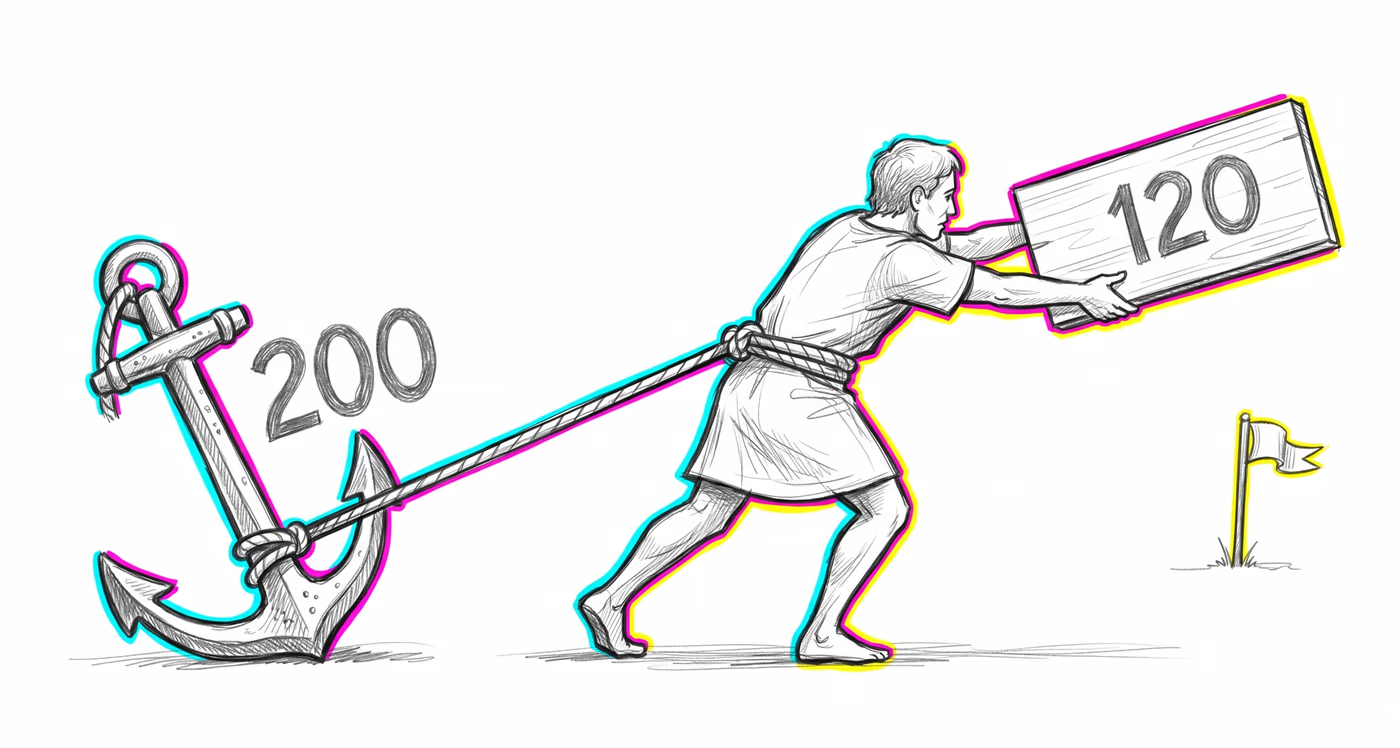
Making decisions based solely on what can be measured while ignoring important things that can't be easily quantified.

Illustration: McNamara Fallacy
WHAT IT IS

The glitch, explained plainly.

Imagine you're trying to figure out if your garden is healthy, but you only count how many flowers you see. You ignore whether the soil is good, whether bugs are eating the roots, or whether it needs more water—because those things are harder to count. Pretty soon you think your garden is great just because you counted a lot of flowers, even though it's actually dying underneath.

The McNamara Fallacy describes a progressive four-step descent in judgment: first measuring what is easily quantifiable, then disregarding what cannot be easily measured, then presuming unmeasurable factors are unimportant, and finally concluding they do not exist at all. This creates a dangerously narrow decision-making lens where complex, multidimensional problems are reduced to a handful of convenient numbers. The fallacy is especially insidious in domains involving human behavior, motivation, culture, and morale—factors that resist neat quantification but profoundly shape outcomes. Organizations trapped by this fallacy often produce green dashboards and favorable KPIs right up until catastrophic failure reveals everything the metrics missed.

SOUND FAMILIAR?

Where it shows up.

  1. 01 A hospital administrator notices that patient wait times have decreased by 15% after a new scheduling system. She declares the initiative a success and expands it hospital-wide, never investigating the fact that patient satisfaction surveys show a sharp decline because doctors now feel rushed and spend less meaningful time with each patient.
  2. 02 A VP of Engineering tracks lines of code committed per developer per sprint as a productivity metric. When a senior engineer who mentors junior developers, writes thorough documentation, and catches critical architectural flaws in code reviews ranks lowest on this metric, the VP puts her on a performance improvement plan.
  3. 03 A school district evaluates its teachers exclusively by standardized test score improvements. A beloved teacher who inspires lifelong curiosity, teaches critical thinking, and has former students who credit her with changing their lives receives a poor performance rating because her students' test scores are merely average.
  4. 04 A startup CEO reports to the board that the company is thriving because monthly active users have tripled. She dismisses a product manager's warning that user engagement depth has collapsed, churn is accelerating, and the growth is driven entirely by a promotion that attracts users who leave within a week, reasoning that engagement metrics are 'soft' and user count is what investors care about.
  5. 05 A government agency measures its anti-poverty program's success by the number of job placements made. The numbers look excellent, so funding is increased. However, no one tracks whether the placed individuals stay employed, whether the jobs pay a living wage, or whether participants' overall wellbeing has improved—because those outcomes are harder to track and take years to materialize.
IN DIFFERENT DOMAINS

Where it shows up at work.

The same glitch looks different depending on the terrain. Finance, medicine, a relationship, a team — same mechanism, different costume.

Finance & investing

Investment decisions become fixated on easily quantifiable metrics like P/E ratios, quarterly earnings, or revenue growth rates while ignoring harder-to-measure factors like management quality, company culture, competitive moat, or long-term strategic positioning—leading to overvaluation of companies that look good on paper but are structurally fragile.

Medicine & diagnosis

Clinical trials and treatment decisions overweight easily measurable endpoints like progression-free survival or blood marker levels while underweighting patient quality of life, functional capacity, psychological wellbeing, and treatment burden—leading to therapies that extend measurable survival metrics without improving the patient's lived experience.


Education & grading

Student learning is reduced to standardized test scores, causing curricula to narrow around testable content while creativity, critical thinking, collaboration, ethical reasoning, and intrinsic motivation to learn—qualities that matter enormously for long-term outcomes—are systematically deprioritized because they resist easy measurement.

Relationships

People evaluate relationship health through countable proxies—frequency of date nights, number of gifts given, social media posts together—while ignoring harder-to-quantify dimensions like emotional safety, depth of communication, mutual respect, and growth, leading to relationships that look good externally but feel hollow.

Tech & product

Product teams optimize for easily tracked metrics like click-through rates, page views, and daily active users while ignoring user frustration, trust erosion, and long-term brand perception. Features that juice short-term engagement metrics get prioritized over those that build genuine user satisfaction and loyalty.

Workplace & hiring

Performance reviews rely heavily on quantifiable output metrics—sales numbers, tickets closed, lines of code—while contributions like mentoring, knowledge sharing, team morale, and cross-functional collaboration go unrecognized because they are difficult to measure, causing organizations to inadvertently punish their most valuable culture-builders.

Politics Media

Policy success is judged by readily available statistics—GDP growth, unemployment rate, crime statistics—while civic trust, social cohesion, institutional legitimacy, and citizen wellbeing are dismissed as too subjective to matter, leading to policies that optimize headline numbers while hollowing out the social fabric.

HOW TO SPOT IT

Ask yourself…

  • Am I making this decision primarily because the data is easy to measure, or because it's the most important information?
  • What crucial qualitative factors am I ignoring right now because I can't put a number on them?
  • If I removed all the metrics, what would my gut and experience tell me about this situation—and why am I dismissing that signal?
HOW TO DEFEND AGAINST IT

The playbook.

  • For every key metric you track, explicitly name at least one important qualitative factor that the metric does NOT capture, and establish a process for monitoring it.
  • Conduct regular 'metric audits' asking: What behaviors does this metric incentivize? What important outcomes does it ignore? Could someone game this metric while making things worse overall?
  • Build qualitative check-ins into decision processes: structured interviews, narrative assessments, ethnographic observation, or open-ended surveys alongside quantitative dashboards.
  • Apply the 'dashboard fire test': If your dashboard showed all green while the building was on fire, what would you wish you had been tracking?
  • When someone raises a qualitative concern, resist the reflex to demand numerical proof. Instead ask: What evidence—of any kind—would help us understand this better?
FAMOUS CASES

In history.

  • The Vietnam War: Robert McNamara's reliance on enemy body counts as the primary measure of war progress, ignoring morale, political dynamics, civilian sentiment, and guerrilla warfare realities, contributing to strategic miscalculation and ultimate U.S. defeat.
  • The 2008 Financial Crisis: Risk models at major financial institutions focused on quantifiable metrics like credit ratings and value-at-risk calculations while ignoring systemic interdependencies, moral hazard, and the qualitative deterioration of lending standards.
  • The Wells Fargo fake accounts scandal: Employees were evaluated almost exclusively on the number of new accounts opened, leading to the creation of millions of fraudulent accounts as qualitative measures of customer trust and ethical conduct were ignored.
WHERE IT COMES FROM
Academic origin

Daniel Yankelovich, 1971. Coined the term in a speech titled 'The New Odds' at the 11th Annual Marketing Strategy Conference of the Sales Executives Club of New York (October 15, 1971), and published a condensed version in 'Interpreting the New Life Styles' in Sales Management magazine (November 1971). Named after Robert McNamara, U.S. Secretary of Defense (1961–1968).

Evolutionary origin

In ancestral environments, concrete and countable information—such as the number of predators, the quantity of stored food, or the distance to shelter—was directly actionable and survival-relevant. Brains that could quickly tally tangible resources and threats made faster, more decisive choices. Abstract, hard-to-quantify factors like group cohesion mattered too, but the bias toward the countable was usually a safe enough shortcut in small-scale, relatively simple environments.

IN AI SYSTEMS

How the machines inherit it.

Machine learning systems are highly susceptible to this fallacy because they can only optimize for what is encoded as a quantifiable objective function. Models trained on easily measurable proxy metrics—clicks, engagement time, prediction accuracy on narrow benchmarks—can systematically ignore harder-to-measure values like fairness, user wellbeing, long-term societal impact, or contextual appropriateness. LLM evaluation suffers similarly when benchmark scores are treated as comprehensive measures of capability while ignoring reasoning depth, truthfulness, and alignment with human values.

Read more on Wikipedia
FREE FIELD ZINE

10 glitches quietly running your life.

A free field-zine PDF — ten cognitive glitches named, illustrated, with a defense move for each. Plus the weekly Glitch Report on Fridays — one bias named, two spotted in the wild, one defense move. Unsubscribe any time.

EXPLORE MORE

Related glitches.

LAUNCH PRICE

Train against your blindspots.

50 cards are free to preview. Buyers unlock the rest of the deck plus the interactive training — Spot-the-Bias Quiz unlimited, Swipe Deck with spaced repetition, My Blindspots, Decision Pre-Flight, the Printable Deck + Cheat Sheets, and the Field Guide e-book. $29.50$59.

Unlock the full deck

Everything below — yours forever. Pay once, use across every device.

Half-off launch — limited to the first 100 readers. Auto-applied at checkout.
$59 $29.50
one-time payment · lifetime access
  • All interactive digital cards — search, filter, flip, shuffle on any device
  • Five training modes — Spot-the-Bias Quiz, Swipe Deck, Pre-Flight, Blindspots, Journal
  • Curated Lenses + Decision Templates + Defense Playbook
  • Printable Deck PDFs + Field Guide e-book + Cheat Sheets + Anki Export
  • Every future improvement, included
Unlock  $29.50

30-day refund · no questions asked

Unlock the full deck

Everything below — yours forever. Pay once, use across every device.

Half-off launch — limited to the first 100 readers. Auto-applied at checkout.
$59 $29.50
one-time payment · lifetime access
  • All interactive digital cards — search, filter, flip, shuffle on any device
  • Five training modes — Spot-the-Bias Quiz, Swipe Deck, Pre-Flight, Blindspots, Journal
  • Curated Lenses + Decision Templates + Defense Playbook
  • Printable Deck PDFs + Field Guide e-book + Cheat Sheets + Anki Export
  • Every future improvement, included
Unlock  $29.50

30-day refund · no questions asked